
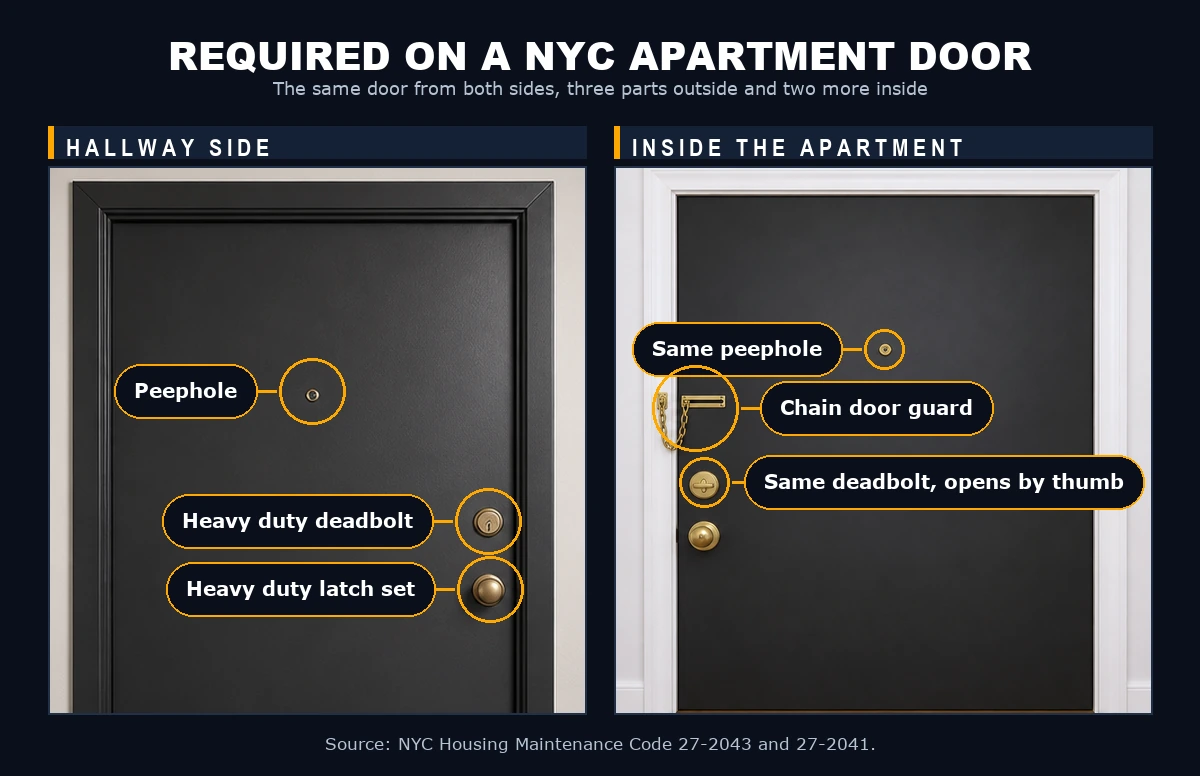
In New York City the building owner has to put a key lock on your apartment door and hand you at least one key. In a normal apartment building the door needs four more things: a heavy duty latch set, a heavy duty deadbolt, a chain door guard, and a peephole. From the hallway the deadbolt is unlocked with a key, while from the inside you turn it open with your thumb. The door also has to swing shut and latch on its own. Most of the lock installation and door closer repair work we do in apartment buildings is bringing a door back to that list.
I am Roye Gvili. I started Top Notch Locksmith & Security in Manhattan in 2010, and my technicians work on apartment and hallway doors in all five boroughs. Tenants call us because a lock is missing or broken. Owners and managing agents call us because an inspector left a violation on the door. By the end of this you will know the five pieces of hardware the city requires, why the self-closing rule is the one being inspected right now, what is not allowed on the door, and how to get a missing or broken lock fixed.
This is general information, not legal advice. It comes from the city code and housing agency sources linked below and from the apartment doors my team works on. Your lease, your house rules, and your building type can change the answer. Read your lease, and ask your managing agent or a tenant attorney about your own situation.
Key takeaways
- Housing Maintenance Code 27-2043 requires a key lock and at least one key on every apartment door.
- In a normal apartment building the door also needs a heavy duty latch set, a heavy duty deadbolt and a chain door guard. From the inside, that deadbolt has to open with a thumb-turn.
- A peephole is required in nearly every apartment under Housing Maintenance Code 27-2041.
- Apartment and hallway doors have to close and latch by themselves. A broken one is a class C immediately hazardous violation. The owner gets 14 days.
- Renters may add one lock of their own. The landlord can ask you for a duplicate key.
5 Things NYC Law Requires on Your Apartment Door
The hardware side of the rule is short, and four of the five items sit in one section of the code. That section covers class A multiple dwellings. Class A is the legal name for a normal apartment building where people live year round, so almost every reader is in one.
- A key lock, and at least one key for you. Section 27-2043 of the New York City Housing Maintenance Code puts both of those on the owner. One key is the minimum. Nothing stops an owner from cutting a second one for a roommate or a partner.
- A heavy duty latch set. This is the lock that holds the door shut when you pull it closed behind you. Heavy duty is the code word, and a light knob set off a hardware store shelf does not meet it.
- A heavy duty deadbolt, key outside and thumb-turn inside. The code names both sides. From the hallway you open it with a key, while from inside your apartment you turn it open with your thumb and no key in your hand.
- A chain door guard. The same section says the door gets a chain guard, so you can open it part way and still look out. This is the piece people take off and never put back, usually after a paint job.
- A peephole. Section 27-2041 puts a peephole in the entrance door of each apartment. It goes where you can stand inside and see anyone right outside your door. The listed exceptions are hotels, apartment hotels, school dormitories, and owner-occupied one and two family homes. Because the owner has to maintain it, that hole is also the catch when a tenant swaps the viewer for a camera, which we cover in what a renter may put on the door.
None of that is about brand or price. The code says what has to be on the door, and says nothing about who makes it, so two doors on the same floor can both pass with completely different locks.
The Self-Closing Door Rule Is the One Being Inspected Right Now
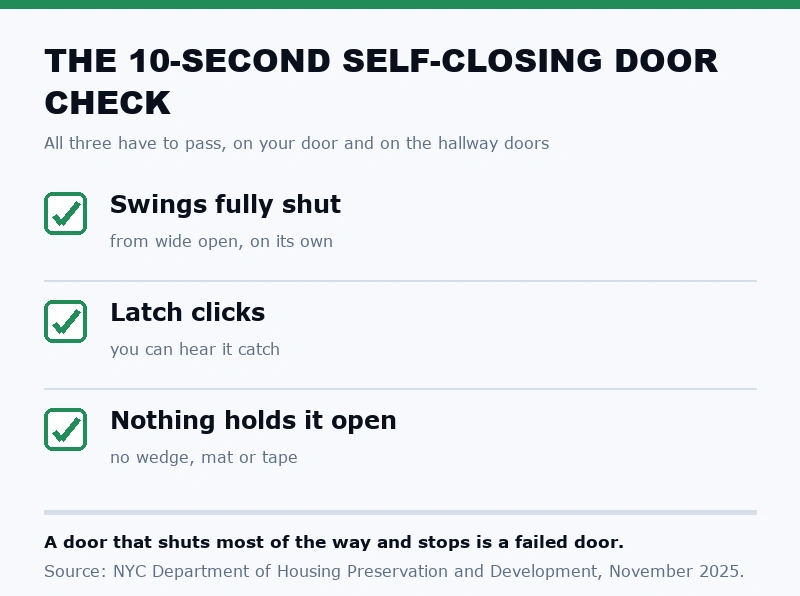
Every apartment door and hallway door in a building with three or more homes has to swing shut and latch on its own once someone lets go of it. That comes from section 28-315.10 of the Administrative Code. Housing Maintenance Code 27-2041.1 makes those doors the owner's job to keep in repair. A door that does not self-close is a class C immediately hazardous violation. The owner gets 14 days. The civil penalty runs from $250 to $500, plus $250 a day from the correction date until it is fixed.
Two things happened recently that put this hardware in front of everyone. On April 24, 2026 the New York City Fire Department released a public service announcement after a fire three days earlier at 660 East 187 Street in the Bronx. Fire marshals found multiple doors left open. One of them was the door of the apartment where the fire started. Smoke and flames reached the hallways, the staircase and every floor. Two people were killed. And in November 2025 the Department of Housing Preservation and Development put out its own reminder. The point of these doors is that nobody has to remember to close them.
The enforcement is real and it is running now. Local Law 71 of 2022 came after the Twin Parks fire in the Bronx. It tells the housing agency to pick 300 apartment buildings a year and inspect them door by door, whether or not anyone complained. The agency reported the results to the City Council for July 2024 through June 2025. Inspectors checked 9,654 doors in those 300 buildings. About 70 percent worked properly. The rest drew 2,937 violations. All but 11 of the 300 buildings got at least one. Owners fixed and certified about 76 percent of them. The next 300 buildings are being inspected during the year that runs to June 2026.
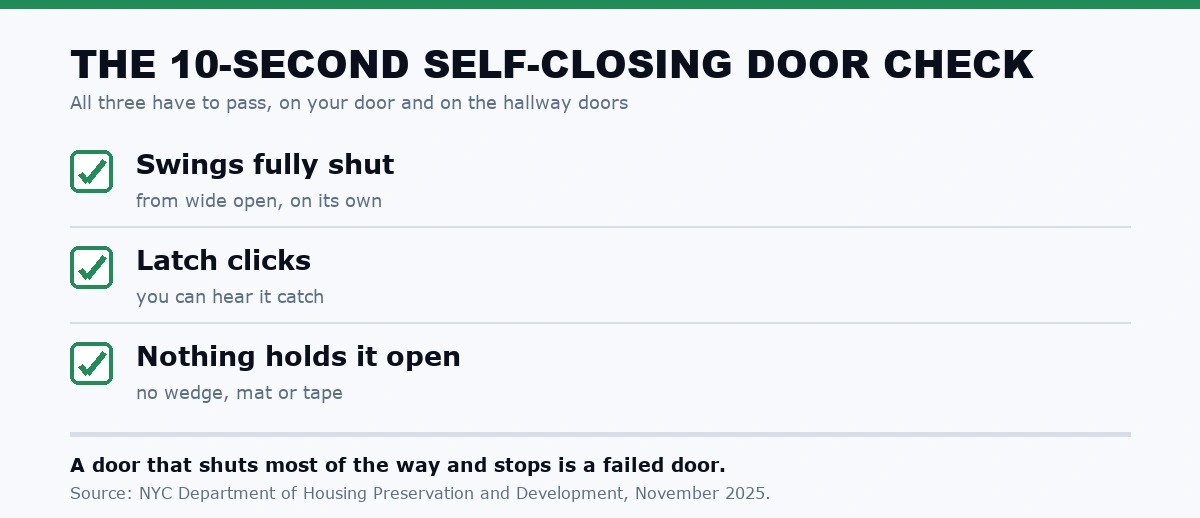
You can check your own door in about ten seconds. The housing agency published the same test it gives its inspectors.
3 Things That Are Not Allowed on an Apartment Door
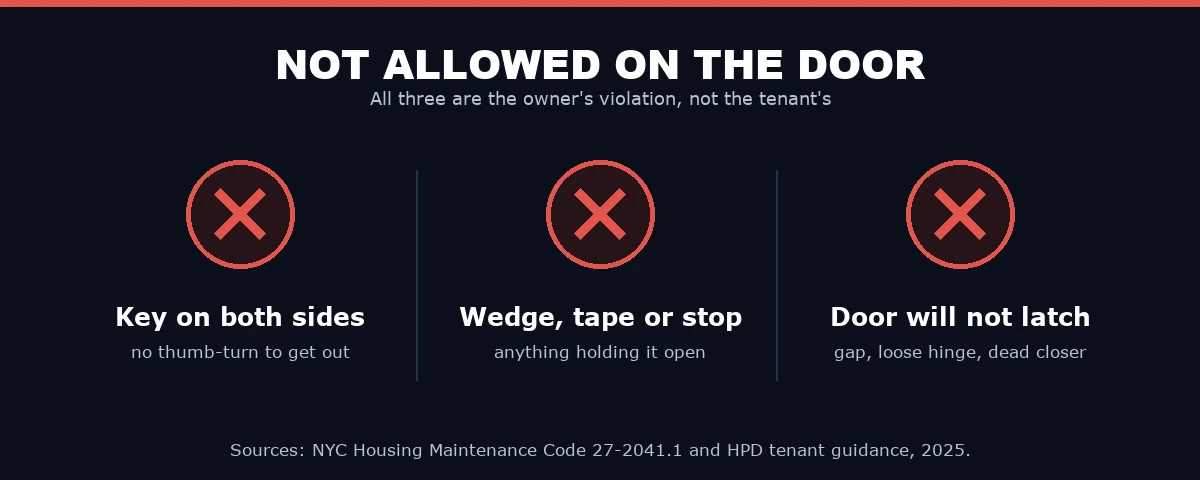
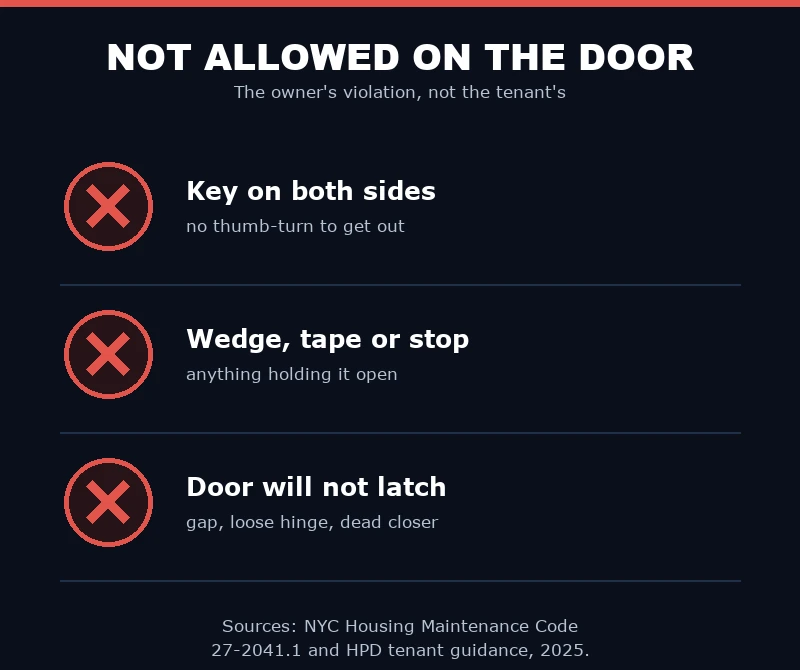
These are the three I get called about most, and all three come up on inspections.
- A deadbolt that needs a key on the inside. From inside the apartment the required deadbolt has to turn with a thumb-turn, so a lock keyed on both sides fails that test. It is also the hardware the Fire Department warns about. In smoke and in the dark you will not find a small key.
- Anything that holds the door open. The housing agency spells this out for tenants: no propping doors with objects, no tape on the latch, no wood wedges, no kick-down stops, and no taking the closer apart. Even a thick floor mat counts, because it slows the swing down.
- A door that no longer meets the frame. A gap at the bottom, loose or missing hinges, a shifted frame, a closer that leaks. The door stops latching, and the closer is usually the part at fault. An inspector writes it up even when the lock itself is fine.
Tenants ask me this every time, so I will say it plainly. Violations for these go to the building owner, not to you. Report the door and the paperwork goes to the owner.
What the Building Front Door and Lobby Have to Have
Your apartment door is one set of rules. The front of the building is another. Those rules come from state law, not the city code. Section 50-a of the New York Multiple Dwelling Law covers buildings put up or converted after January 1, 1968. Every entrance from the street, a court, a yard or the cellar gets automatic self-closing and self-locking doors. Those doors stay locked at all times unless an attendant is actually on duty. What holds that street door shut is either a magnet or the latch in its frame, and the two behave very differently in a blackout.
The same section covers the buzzer. A building with eight or more apartments needs an intercom. The person in each apartment has to be able to speak to whoever is standing at the main entrance. Older buildings can get one too, once a majority of tenants ask in writing, and the statute then puts a clock on the owner. We wrote up the tenant side of a dead buzzer in apartment intercom not working, and the hardware side lives on our intercom installation page. If your building swapped its keys for fobs, read can you copy an apartment key fob, which covers what the city allows an owner to do with that system.
What You Can Add Yourself as a Renter
You are allowed one lock of your own. Section 51-c of the Multiple Dwelling Law lets a tenant install one lock, no more than three inches in circumference, separate from the lock the owner installs and maintains. A lease clause charging you a fee for that right is void. The trade is the key, and a duplicate goes to the owner or the agent on request.
Three notes from our jobs. A rekey is usually all somebody actually wants, because it kills the old keys and needs no new hardware. An electronic lock does not remove the duplicate key duty, and boards often say no. We cover that in smart locks in a NYC rental. And a lock change is a different question from a landlord changing your locks, which we cover in can my landlord change the locks. If the lock you are weighing is the surface case with a bolt that slides up and down, we compare it with a normal deadbolt in jimmy-proof lock against deadbolt.
How to Get a Missing or Broken Lock Fixed
Missing hardware and a broken closer follow the same path, and it starts with the owner.
- Tell the owner or managing agent in writing. Text or email is fine. Name the door, name the part, keep the date. Most problems get fixed at this step.
- Call 311 if it does not get fixed. The housing agency takes complaints about a missing lock, a missing peephole and a door that will not self-close. It sends an inspector.
- Let the violation run its course. A self-closing door violation is class C and the owner has 14 days. The agency re-inspects after that, whether or not the owner certified the repair. If the condition is still there, the agency can send its own contractor under its emergency repair program. The cost goes on the property.
On the owner and agent side, the cheap move is checking doors before an inspector does. In the same report, owners who got advance notice corrected about 76 percent of their violations, while citywide the rate is closer to 50 percent. These are small repairs when somebody actually looks. A closer, a hinge, a strike plate, a chain guard, a peephole. We handle those on a single visit, along with door hardware and lock changes when the part is past repair.
Top Notch Locksmith & Security is a licensed and insured locksmith and security company based in Manhattan. We work on apartment doors, co-ops, condos, hallway doors and commercial entrances across the five boroughs of New York City. Code hardware, closers and high security cylinders are daily work for my team, so we see which doors pass and which ones get written up.
Frequently Asked Questions
Does my landlord have to give me a key to my apartment?
Yes. Housing Maintenance Code 27-2043 says the owner of a dwelling provides a key lock in the entrance door of each apartment and at least one key. If the lock was changed and no key reached you, that is not a hardware problem anymore, it is a lockout.
Is a deadbolt with a key on both sides legal in a NYC apartment?
Not as the deadbolt the owner is required to provide. The code says that deadbolt works with a key from the outside, while from the inside it has to turn with a thumb-turn. A lock that makes you find a key to get out is the hardware the Fire Department warns about. In smoke you will not find that key.
Does my apartment door need a peephole in New York City?
In almost every apartment, yes. Housing Maintenance Code 27-2041 puts a peephole in the entrance door of each apartment unit, and the owner has to maintain it. The listed exceptions are hotels, apartment hotels, school dormitories, and owner-occupied units in one and two family homes.
Who pays to fix an apartment door that will not close by itself?
The owner. Housing Maintenance Code 27-2041.1 makes self-closing doors the owner's duty to keep in repair. A broken one is a class C immediately hazardous violation with 14 days to correct. If the owner does not fix it, the housing agency can send its own contractor and bill the property.
How long does my landlord have to fix a broken lock on my apartment door?
Ask the owner in writing first, then call 311 if nothing happens. When the housing agency writes up a violation, the notice it mails has to name the date the repair is due, and the code sets those dates: ninety days for a non-hazardous violation, thirty days for a hazardous one, and twenty-four hours for an immediately hazardous one. Which of the three a broken lock gets is the inspector's call on the day, so put your request in writing with a date on it, because nothing official begins until you do.
I am locked out of my apartment in Manhattan. Does my landlord have to let me in?
The owner has to give you a key lock and at least one key, and nothing in the code says somebody has to drive over at two in the morning. In a building with a live-in superintendent, that person usually can and usually will. What the owner may never do is change your lock to keep you out, which is a separate law. If nobody is answering, work through the free options before you call a locksmith, starting with the super and whoever else is on the lease.
Can my co-op or condo board tell me which lock to install?
Often yes. On top of what the city requires, a board can set house rules about cylinders, keyways and who holds a key for emergency access. Ask the managing agent before you buy hardware. A cylinder the building will not accept is money spent twice.
Need Code Hardware Put Back on the Door?
Maybe you are a tenant with a missing chain guard or peephole. Maybe you are an owner or managing agent looking at a self-closing door violation with 14 days on it. We work on apartment and hallway doors across the five boroughs and answer the phone 24 hours a day. Call (646) 781-7070 or tell us what is wrong with the door, and we will tell you what the door needs to pass.