
You have one fob for your building and you need a second one. Your partner moved in, or yours cracked on the sidewalk, or management wants a fee and two weeks to issue another. So you look at the little black tag on your keyring and wonder whether anybody can just copy it.
People ask me that on key fob entry calls every week, usually right after a building swapped its old brass keys for readers. The second question is always the same one: am I even allowed to, and is this my landlord's call or mine?
Some apartment key fobs copy in about ten seconds and some cannot be copied at all. The chip inside decides whether a copy is possible, and your lease decides whether you are allowed to have one.
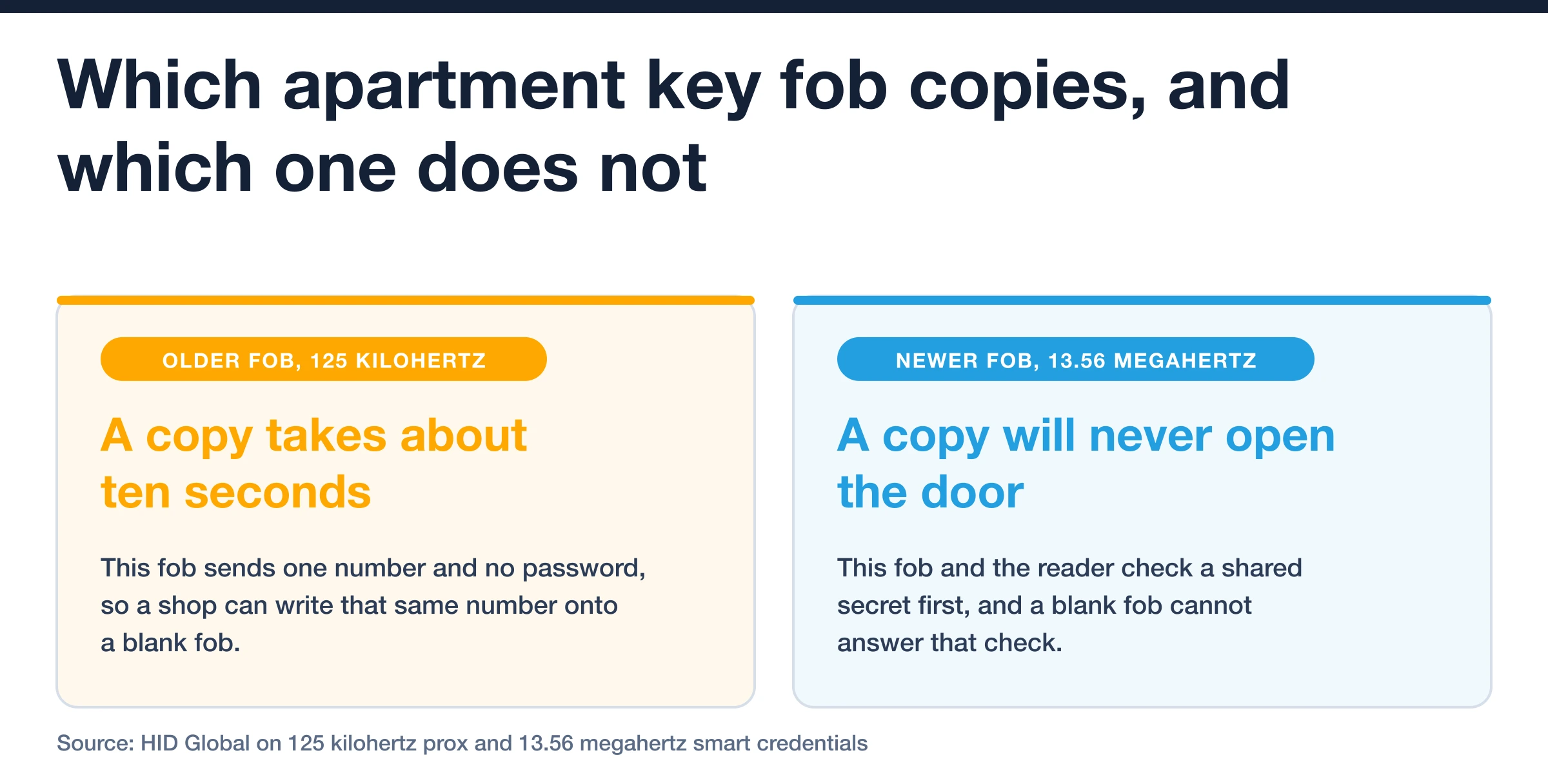
- Older low frequency fobs, the 125 kilohertz kind, carry one number and no password, so a locksmith or a kiosk can write that same number onto a blank fob.
- Newer 13.56 megahertz fobs swap a secret with the reader before the door opens, and a blank fob cannot answer that question. No copy exists for these.
- A copy repeats the credential your building already gave you. It adds no new access, and it stops working the day management switches that number off.
- Your lease usually says the fobs are the owner's property and you return them when you leave. Some leases say plainly that copying them is not allowed.
How I know: HID makes a good share of the readers hanging in New York City vestibules. HID says its own older prox fobs were never encrypted and can be cloned. The newer credentials check the reader back before they answer it.
I am Roye Gvili, and I run Top Notch Locksmith & Security out of Manhattan. My technicians work on apartment buildings in all five boroughs, and fob questions have gotten louder every year that another building goes keyless.
By the end you will know which fob is on your keyring, whether a copy will actually open your door, what a copy can never do, what your building can demand, and what New York City law says your landlord may and may not do with that system.
Key takeaways
- Find out which fob you have before you pay anybody. A shop that copies encrypted fobs is selling you a blank that will not open the door.
- A copy is a repeat of your own credential. Management can switch that number off, and your copy stops working in the same moment.
- Buying a copy does not put anyone into the building's records, so if your building keeps a list of who holds what, a copy is invisible on it.
- Your landlord cannot make you use the fob system to get into your own apartment. That has been New York City law since 2021.
- A state bill that would hand every tenant a fob at no cost passed the Senate on June 4, 2026. It is sitting in an Assembly committee and is not law.
Can you copy an apartment key fob?
Sometimes, and here is what actually happens when you touch your fob to the reader by the door. Your fob has no battery in it. The reader throws out a small radio field, the fob wakes up on that field, and then the fob sends back what it has stored.
On an older fob, what it sends back is one number, every time, with nothing protecting it. That is the whole conversation.
A copier holds the same kind of radio field, reads that number, and writes it onto a blank fob, and the blank now says exactly what your fob says. HID, the manufacturer, puts it plainly in its own history of these credentials: prox devices "were not encrypted and could be easily cloned or spoofed."
A newer fob has a conversation instead of a speech. The reader asks a question, the fob answers using a secret key stored inside it, and the fob checks the reader in return before it hands anything over.
HID calls that mutual authentication. A blank fob has none of the secrets, so it fails the question and the door stays shut. That is why key fob cloning works on some buildings in this city and is a waste of money on others.
A hardware store can duplicate a house key in a minute, and people expect a key fob to work the same way. Shops that advertise an RFID key fob copy, which is short for radio frequency identification, mean the older kind.
Which fob do you have? Three ways to tell
You can usually work this out in a couple of minutes without paying anybody. Here is what I check before I quote a tenant for a copy.
- Read the back of the fob. Turn it over and look for small printing. A long number stamped or laser marked on the back is normal on the older fobs, and so is a name like ProxKey. Take a photo of both sides and a shop can answer you from that.
- Ask management what the system is called. One email to the super or the managing agent, asking which access control system the building runs, gets you a brand name. A newer name means the credential checks the reader back, and that means nobody can copy it.
- Let somebody read it in front of you. A locksmith with a reader can tell you in seconds which family your fob belongs to. Ask for that answer before you pay for a copy, and be careful with any shop that quotes you a price without ever putting your fob on a reader.
A copy is not the same as a fob from management
This is the part that surprises people who already paid for one. A copy carries the number your building issued you. It does not create anything new in the building's system, so nobody in the office knows the second fob exists.
A replacement key fob from your apartment building is a different thing, because management issues it and writes it into their own records.
That cuts both ways. When you report your original lost and management switches that number off, your copy goes dead in the same moment. The reader is refusing that number, not the piece of plastic in your hand. A fob issued by the building is its own record, so it keeps working after your old one is switched off.
The same split shows up with mechanical keys, where a restricted key is controlled by who is allowed to cut it, not by whether a machine physically can. With fobs, the control moved into the chip and into the building's software.
What your lease and your building can do about it
Copying your own building fob is not a crime in New York, and I want to be clear about that before the rest of this. What it can be is a breach of your lease, which is a different kind of problem and a real one.
Read the clause about keys and fobs in your lease. Most of them say three things: the fobs belong to the owner, you return all of them when you move out, and you pay for any you do not return.
Some go further and say you will not duplicate them. Management can also switch off a fob they think is unaccounted for, which usually ends with you in the office explaining the second one.
So the useful move is to ask management for another fob in writing first, and keep their answer. If they refuse, or the fee is high, you at least have a dated email showing you asked, which is worth more than a copy nobody knows about.
What New York City law says about your building fob
Here is the part almost nothing else written about fobs covers, and it is the part that protects you. New York City has a law about keyless entry buildings, and it has been on the books since 2021.
It is called the Tenant Data Privacy Law, Local Law 63 of 2021.
It covers any building that grants entry with a fob, a card, a phone app or a fingerprint.
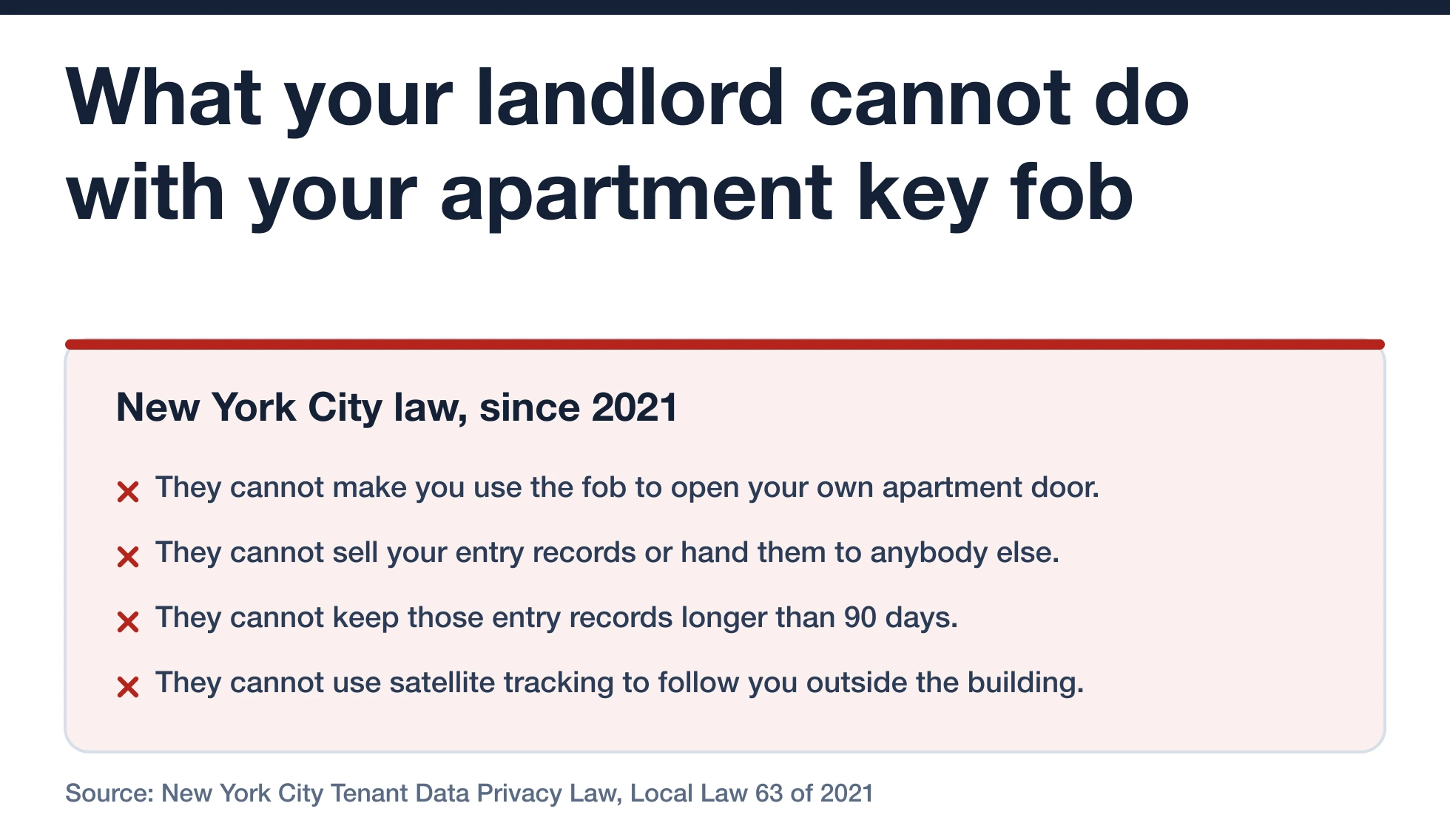
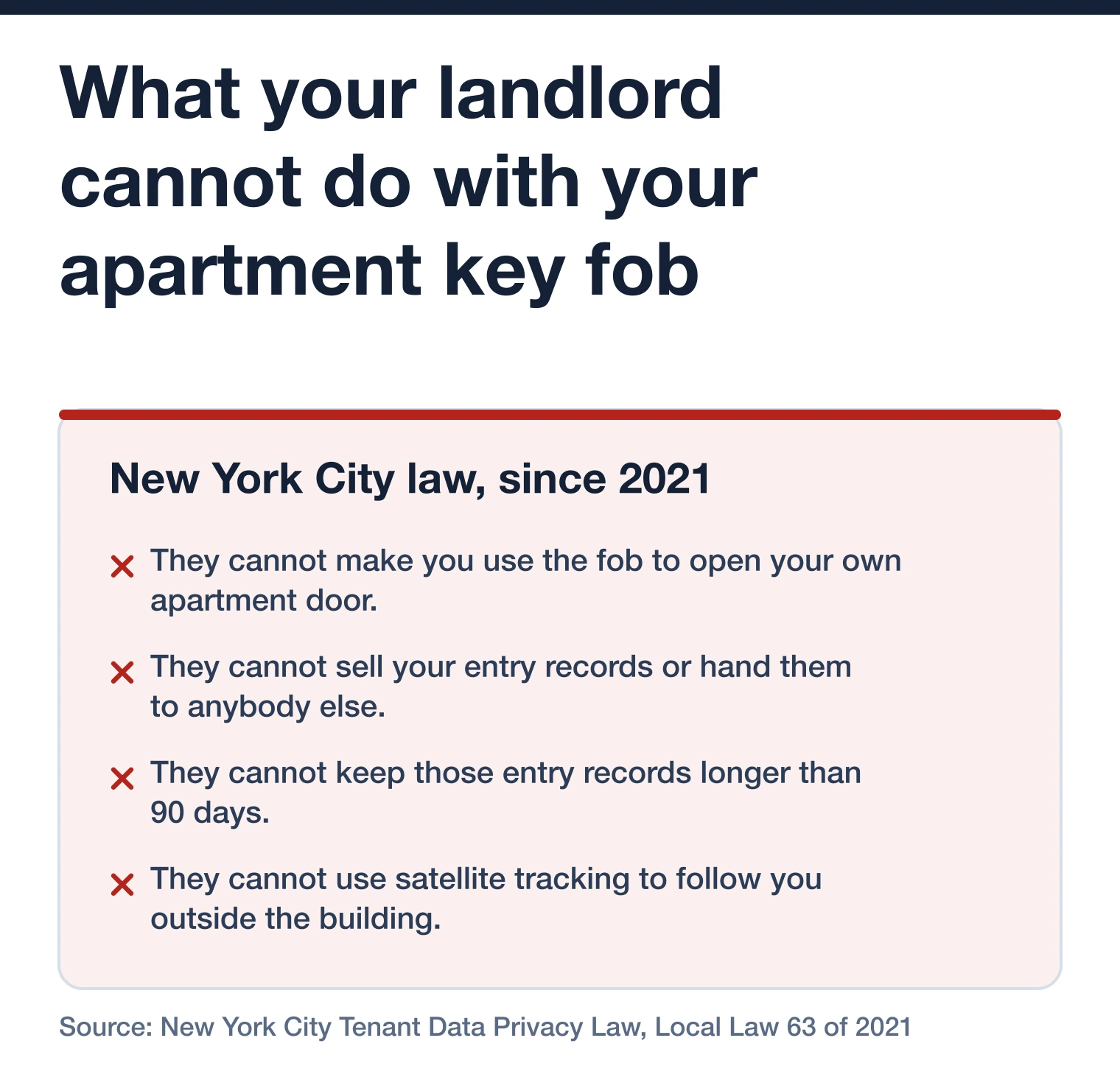
The city's Department of Housing Preservation and Development lists what an owner has to do. The owner gets your consent in writing or through an app before collecting anything. The owner hands you a privacy policy in plain language.
The owner collects only a short list of details. And the owner destroys the entry records the system makes within 90 days.
Three lines in that law matter more than the rest. An owner may not sell or hand your data to anyone else, with narrow exceptions. An owner may not use satellite tracking to follow you outside the building. And an owner may not require you to use the smart access system to get into your own apartment.
That last one sits alongside the older city rule in Housing Maintenance Code 27-2043, which says the owner provides a key lock on your apartment door and at least one key.
If the entry records worry you, the same thinking runs through what a tenant may put on their own door, where the recording rules are stricter than most people expect.
Albany may add to this soon. Senate Bill S10635, sponsored by Senator Brian Kavanagh, passed the Senate 36 to 24 on June 4, 2026 and now sits in the Assembly housing committee.
It is not law. If the Assembly passes it and the governor signs it, every lawful tenant and occupant would get a key, fob, digital key or card at no cost. A building could not run entry through a phone app alone. And no new system that scans fingerprints or faces could go into an apartment building.
Your fob stopped working. What now?
Start by ruling out the fob itself. Hold it flat against the middle of the reader for a full second, try the other entrance if your building has one, and try it right after somebody else's fob works.
A fob that fails at every reader while other people get in is usually switched off in the software, which only management can undo.
A whole door full of tenants failing at once is a different problem. That is the reader, the controller or the power to it, and it is the owner's repair.
Housing Maintenance Code 27-2005 puts the duty to keep the building in good repair on the owner, so put the request in writing, date it, and call 311 if the owner does not send anybody. A propped entrance door is nobody's repair, and neither is an intercom that stopped answering at the same time.
Frequently Asked Questions
Can I put my building fob on my phone instead?
Only if your building runs a system that issues phone credentials, and that is a change management makes on their side. There is no app that turns a plain fob into a phone key. What some people do instead is carry the fob in a card holder on the back of the phone, which is not the same thing and does not always work, because a phone case with metal or a wallet full of other cards can stop the reader seeing it.
My roommate is not on the lease. Can they get a fob?
Ask management, because the building is the one that adds a person to the system. New York City law gives you a way to do it: a tenant can authorize a guest to be granted access through the smart access system, and the building has to remove that guest from the system within 90 days of you withdrawing the request. What the law does not do is tell an owner how many fobs to hand out, so the number is a lease and management question.
My building charges me for a replacement fob. Is there a cap on that?
Not one I can point you to in the New York City code today. The fee is whatever your building and your lease say it is, which is why people go looking for a copy in the first place. The state bill that passed the Senate this year would change that for everyone: it says every lawful tenant and occupant gets a key, key fob, digital key or key card at no cost. It is not law yet, so it does not help you this month.
Do I have to hand the fob back when I move out?
Almost every lease says yes, and most of them let the owner charge you for one you do not return. Hand back every fob you were issued, including copies you had made, and ask for an email confirming what you returned and when. A copy you keep is no use anyway once management deactivates the number, and a building that finds an unreturned fob in your name will bill you for it.
Is there any reason a locksmith would refuse to copy my fob?
Two, and both come up on real jobs. The first is that the fob is encrypted and there is nothing to copy, so any shop that promises one is selling you a blank that will not open the door. The second is authorization. Handing a stranger a working credential to a building they may not live in is how a copy ends up in the wrong pocket, so expect to be asked what building it is and whether you are the tenant.
Not Sure Which Fob You Have?
Send us a photo of both sides of your fob and we will tell you whether a copy is possible before anybody pays for anything. We work on building access systems across Manhattan, Brooklyn, Queens, the Bronx and Staten Island. Call (646) 781-7070 or send the photo through our contact page.