
You need one more key. A roommate moved in, or a parent is coming to stay, or you are tired of being the only person in the apartment who can get through the door. Then you look at the key and there it is, stamped across the head: DO NOT DUPLICATE. The hardware store already handed it back to you. So now you are wondering whether copying it is against the law, whether a locksmith is allowed to do it, and what happens if you just walk in and ask. Most of the key cutting calls we take start with somebody holding a key they were told they cannot copy, and plenty of them turn into a high security lock talk instead.
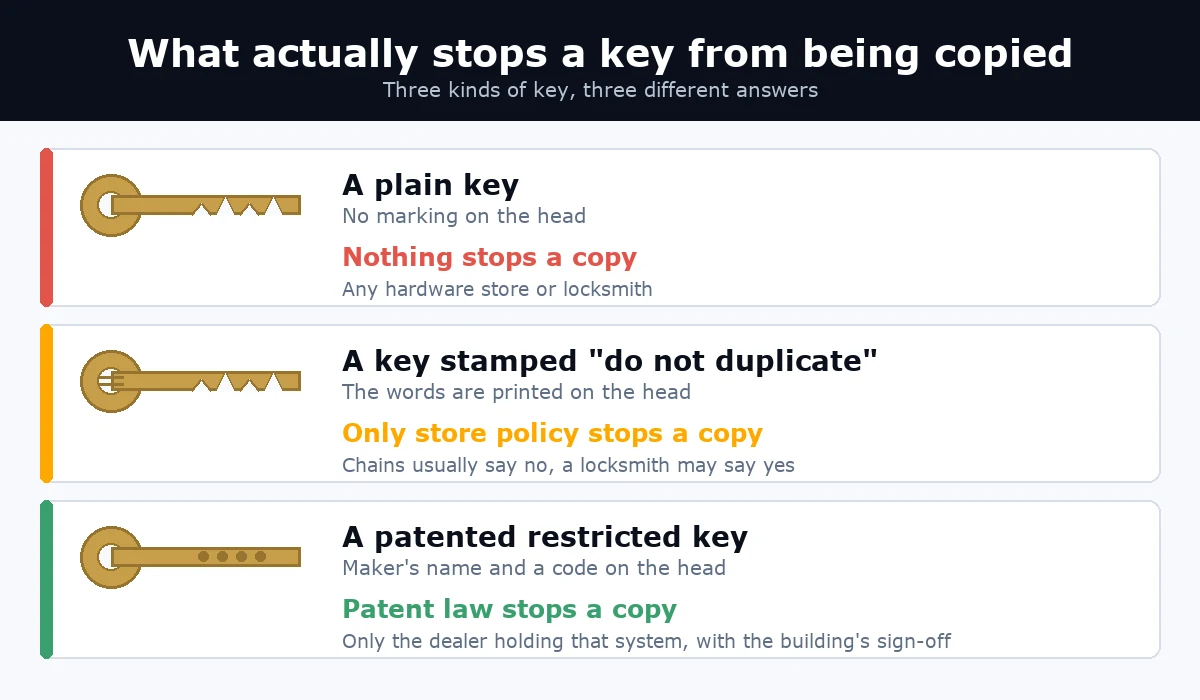
Yes, in most cases a locksmith can legally copy a key stamped "do not duplicate," because those words are a request from whoever ordered the keys and not a law.
- The stamp by itself carries no legal weight, so nothing in it makes a copy a crime.
- What actually blocks a copy is a patent on the key blank, which is a different thing from the stamp.
- A locksmith can still say no, and a good one will ask you to show that the key is yours to copy.
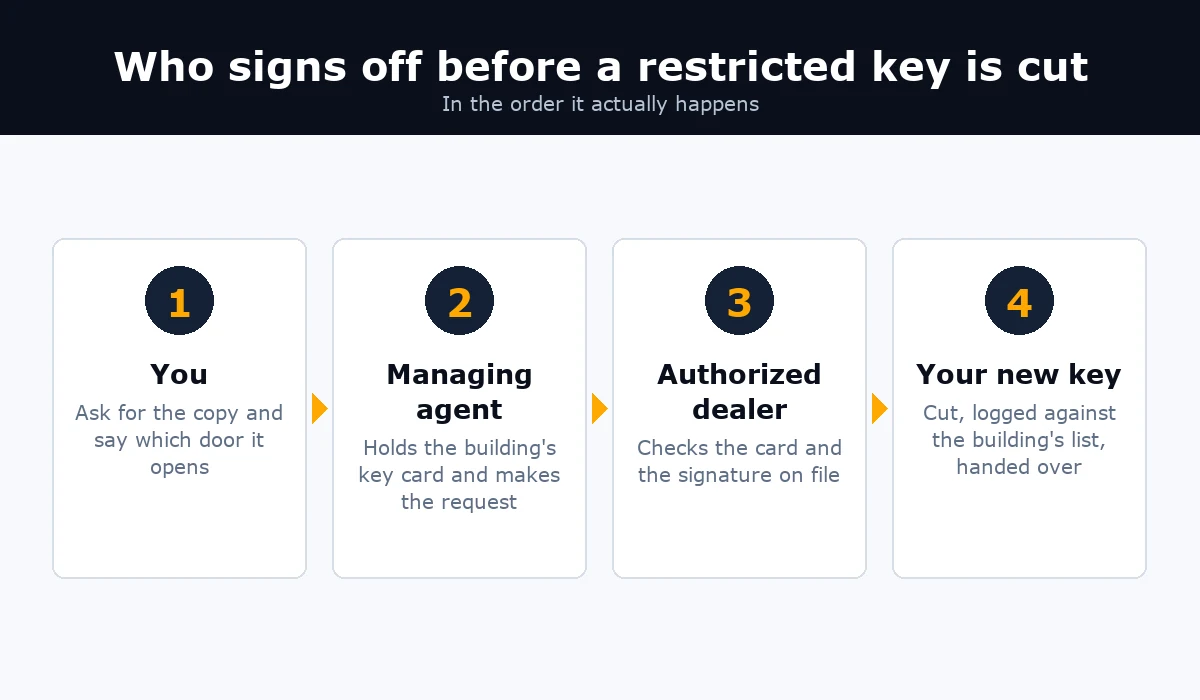
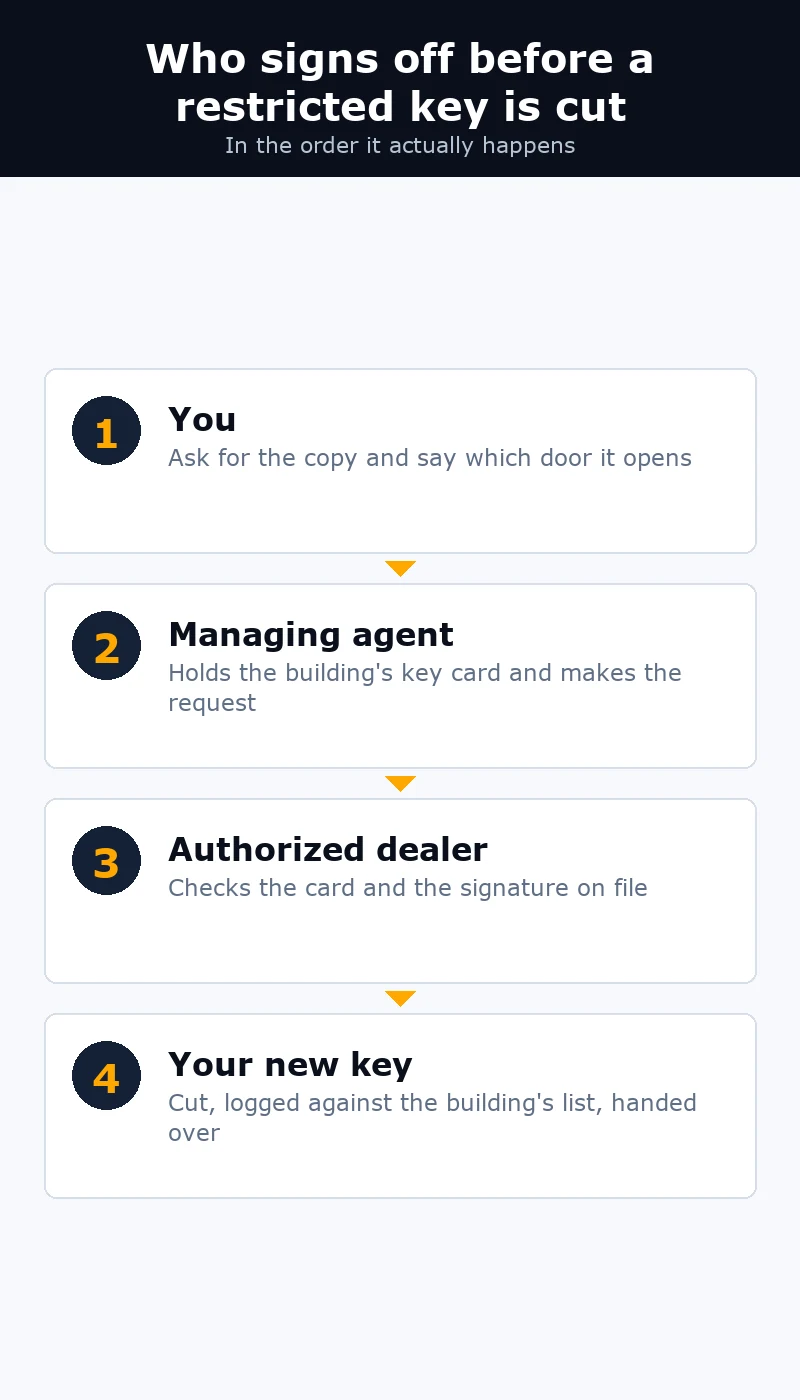
- If your key runs on a patented building system, only the dealer who holds that system can cut it, and the building has to sign off.
Where that comes from: Medeco, one of the companies whose keys carry that stamp, says plainly on its own site that the wording is not legally binding, while the real control sits in patent law.
I am Roye Gvili. I started Top Notch Locksmith & Security in Manhattan in 2010, and my technicians cut keys for apartments, offices and building systems across the five boroughs. By the end you will know what the stamp means, what does stop a copy, what I ask for before I cut one, what your building owes you, and what to do when nobody will make you a key.
Key takeaways
- The words on the key are a request. A patent on the blank is the only thing that legally stops a copy.
- A United States patent runs 20 years from the day it was filed, so an old restricted system quietly stops being restricted.
- Big hardware stores refuse to cut a key stamped Do Not Duplicate as store policy, not because the law tells them to.
- On a building system, the managing agent usually holds the card that authorizes a copy, so that is your first call.
- A New York City owner has to give you a lock and at least one key, and you may add one lock of your own on top of it.
This is general information, not legal advice. It comes from the city code, the standards linked below and the doors my team works on. Your lease and your building's house rules can change the answer, so read your lease and ask your managing agent before you change anything on a door you rent.
What does "do not duplicate" actually mean?
It means somebody ordered the keys that way. A landlord, an office manager or a building super asks the supplier to stamp the words on the head of the key, and the supplier prints them. That is the whole story. The stamp is not filed anywhere, it is not tied to a law, and it does not change what the key is made of.
Medeco, a lock maker whose own keys often carry that marking, puts it about as plainly as a manufacturer can. In its own published note on the subject, the company says a key printed with "do not duplicate" is not legally binding, and that there are no laws that enforce the wording.
Here is the part that explains your trip to the hardware store. The big chains say no as store policy. It keeps them out of fights with landlords, and it takes the call away from a teenager at a machine. A locksmith makes that call as a trade decision instead, which is why you can hear no in one place and yes in another on the same afternoon. Building fobs run on a different set of rules, and we cover those in can you copy an apartment key fob. So if the stamp is not what stops a copy, what does?
So what actually stops someone from copying a key?
The blank does. Every key starts as an uncut blank, shaped to slide into one particular keyway, and the only way to make you a copy is to have that shape in a drawer. When a lock company patents the shape of its blank, nobody else may legally manufacture it, so the supply runs through that company and the dealers it picks. That is a restricted keyway, and it is the real version of what the stamp only pretends to be.
Patents run out, which is the part almost nobody mentions. Under Title 35, Section 154 of the United States Code, a patent lasts 20 years from the date the application was filed. Once that clock runs out on a keyway, other companies may make the blank. Copies show up, and a system a building has trusted for twenty years is one a corner shop can cut. If your building bought its system a long time ago, ask about this.
A patent and a strong lock are two separate things, and buildings mix them up all the time. The strength side is tested against UL 437, the standard for key locks, now in its eighth edition. That test covers picking and drilling. A patented key can sit in a weak lock, while a strong lock can take a blank anyone can buy. Ask about both. One keeps copies down, the other keeps people out.
4 questions I ask before I cut a key that says do not duplicate
None of these are about the stamp. They are about whether the key in front of me is yours to copy, and you can save yourself a trip by having the answers ready.
- "Whose door does this open?" A key to your own apartment, your own office or your own store is a short conversation. A key to a shared front door, a boiler room or a mailroom belongs to the building, and the building is the one who gets to say yes.
- "Can you show me you live or work there?" A lease, a utility bill in your name, or a driver's license with that address is enough for most apartment keys. Bring it with you, since a locksmith who never asks is a locksmith who would copy your key for somebody else just as easily.
- "Is there a card that came with this system?" Patented systems come with a key card, sometimes called an owner card, carrying a code and a signature on file. Without it, no dealer on that system may cut you a key, and asking somebody else will not help.
- "How many copies are already out there?" When nobody in the building can answer that, another copy is not the fix. That is the point where a rekey costs less than the risk of one more key floating around.
If you rent in New York City, who holds the card?
Almost always the managing agent, and that is your first phone call rather than a locksmith. On a building running a patented master key system, the building is the customer on file, so the say-so sits with the agent or the owner, not with any one tenant. Once they approve it, the copy is a quick job.
You are not empty handed while you wait. Under Section 27-2043 of the New York City Housing Maintenance Code, the owner has to put a key lock in the door of each unit and hand over at least one key. In a class A multiple dwelling that door needs more: a heavy duty latch set, a heavy duty deadbolt, and a chain door guard. From the hallway the deadbolt takes a key, while inside you would turn it with your thumb. So a door with no working key is the owner's problem, not a favor you are asking for.
You have a second option too. New York Multiple Dwelling Law Section 51-c lets you put one lock of your own on your door, up to three inches around. If the landlord or the agent asks for a duplicate key, you give them one. A lease clause charging you extra rent or a fee for that lock does not hold up. We walk through how it plays out on a real door in our post on what your landlord has to install.
What to do when nobody will copy your key
Start by finding out which wall you have hit, because the two look identical from where you are standing and they have completely different fixes. Take the key to a locksmith and ask one question: is this a stamped key on a blank you carry, or a patented keyway you cannot get? You will have your answer in about ten seconds.
If it is only stamped, bring proof of address and the copy gets made. If it is patented, the managing agent has to request it. Put that request in writing and keep the reply. And if the agent will not act at all on a door that is yours, stop chasing that key. A new cylinder on your own door puts you back on a system where you decide who holds a copy, which is what most people wanted anyway. People make the same call after a roommate leaves, and we cover the money side in rekeying versus changing locks.
Frequently Asked Questions
Can someone copy my key from a photo of it?
For a plain key, yes, and that is a good reason to keep yours out of photos you post. The cuts on a standard key are a small set of depths, so a clear picture of the whole key shows them. A patented key is harder to copy this way, because the blank itself is the part that is hard to get hold of, not the pattern of the cuts.
If I stamp "do not duplicate" on my own keys, does that help?
Not really. You would be adding the same words that carry no legal weight to a blank anyone can buy. It may make a hardware store pause, and that is the whole effect. If you want people turned away, you need a key on a patented system, which means changing the cylinder rather than the wording on the key.
My key has a number stamped on it. What is that for?
That is usually a key code, and it tells a locksmith what the cuts should be without seeing the key at all. It is handy when you have lost every copy, since the cuts can be made from the code. It is also a reason not to leave that number where a stranger can read it, and a reason a building should keep its code list somewhere private.
What happens to my restricted key when I move out?
You hand it back. On a building system the keys are tracked and signed for, so the managing agent is expecting a count at the end of your lease. Holding one back is the fastest way to end up billed for a rekey of the whole line, since the building cannot tell where that key ended up.
Is a patented key worth it for one apartment door?
For a single apartment door inside a locked building, usually not, because you would be paying for key control on one door while the front door of the building runs on its own system. It pays off on a shared entrance, an office, or a door where several people have held a key over the years and nobody knows how many copies are out there.
Bring Us the Key and We Will Tell You Which Problem You Have
We cut keys for apartments, offices and building systems across Manhattan, Brooklyn, Queens, the Bronx and Staten Island, and we set up patented systems for buildings that want their copies tracked. Ten seconds with the key in hand tells us whether you need proof of address or a signature from your managing agent. Call (646) 781-7070 or tell us what is stamped on your key.