

Your door knob wiggles when you grab it. You tightened it once already, and a few weeks later it was loose again. Now you are wondering if it comes off in your hand one day while you are on the wrong side of the door. Is this a five minute fix or a new lock? People ask me that on most of the door hardware calls I take. And if you rent, there is a second one: is this even yours to fix?
Almost every loose knob is one of three things: two mounting screws that backed out, a small hidden set screw that let go, or screw holes in the door that are worn out. The first two take about five minutes. The third one makes a knob come loose again after you fix it.
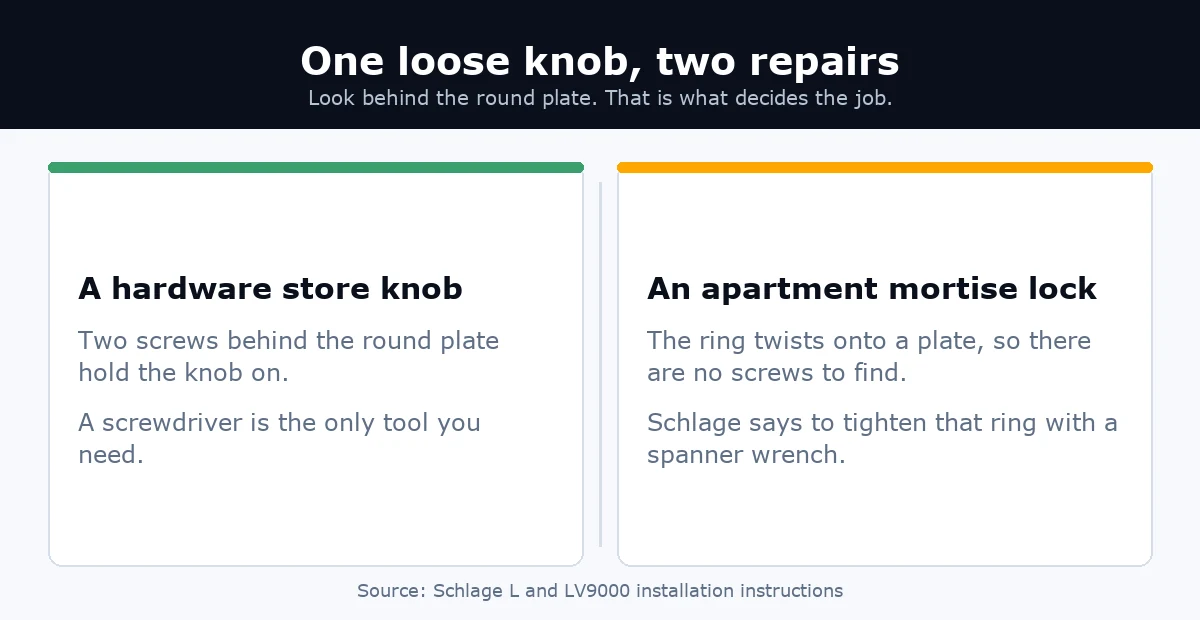
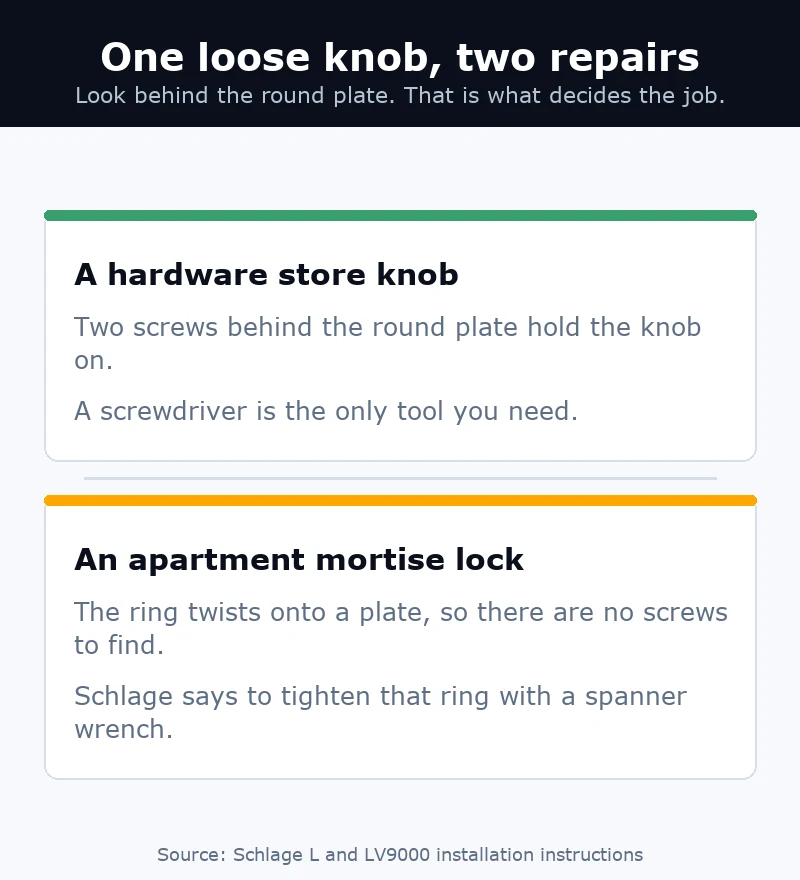
- Look at the round plate behind the knob first. Two visible screws means the easy version, and you are done in five minutes.
- No screws showing means the plate pops or twists off, and there is a tiny screw in the neck of the knob holding everything on.
- If the screws spin and never bite, the wood is chewed out, and tightening harder makes that worse rather than better.
- A city apartment entrance door usually has neither of those, because a mortise lock comes apart in a completely different order.
Where that comes from: Schlage's own install sheets, which tell you to push the knob on and tighten the set screw, and tell you to take the same lock apart with a spanner wrench when it is a mortise lock.
I am Roye Gvili, and I run Top Notch Locksmith & Security out of Manhattan. My technicians work on apartment and house doors in all five boroughs, and loose knobs are the job people put off the longest. By the end you will know which kind of loose you have, how to tighten each one, why an apartment lock is a different animal, why it keeps coming back, and when the knob is not really the problem at all.
Key takeaways
- Find the screws before you pick up a screwdriver. On some knobs they sit behind the round plate, and that is a different job.
- Tighten both sides a little at a time. Crank one side down hard and the knob goes stiff afterward.
- Kwikset lists over-tightened mounting screws as a cause of a lock working badly, so hard is not the same as fixed.
- A door that dropped on its hinges makes you yank the knob harder every day, which is what loosens it.
- When the knob spins and the latch never moves, people get stuck outside. That one is worth a call.
Which kind of loose is it?
Grab the knob and watch what moves. Three different faults get called a loose knob, and they are not the same repair.
| What you feel | What has actually let go | What it takes |
|---|---|---|
| The whole knob wiggles side to side, but it still opens the door | The two screws that clamp the lock through the door have backed out | A screwdriver, five minutes, and no parts |
| The knob slides out and in, or wants to come off in your hand | The small set screw in the neck of the knob has loosened | A tiny screwdriver or a hex key, and five minutes |
| The knob spins all the way around and the latch never moves | The square bar inside, or the piece it turns, is worn or broken | A new lock, because that part is not sold on its own |
The first two rows are yours to do tonight. Start by looking at the round plate sitting flat against the door.
The knob with two screws you can see
This is the common one on interior doors, and it is the easy version.
Here is what those two screws are doing. One knob sits on each side of the door. The screws run from the inside knob, straight through the door, into threaded posts on the outside knob. Turning them pulls the two halves together and clamps the whole lock onto the door. When they back out, nothing is holding the two halves tight, so the knob rocks.
- Match the screwdriver to the screw. A bit that is too small chews the head and then the screw is a problem too.
- Turn both screws a few turns each, back and forth between them. Even pressure keeps the lock square in the door.
- Stop when they feel firm. Then turn the knob and open the door twice. If it feels stiff, you went too far, so back both screws off a quarter turn.
That last step matters more than it sounds. Kwikset lists over-tightened mounting screws among the reasons one of its locks jams or works poorly. Squeezing the two halves too hard pinches the moving parts between them, so the knob turns but the latch drags.
The knob with no screws showing
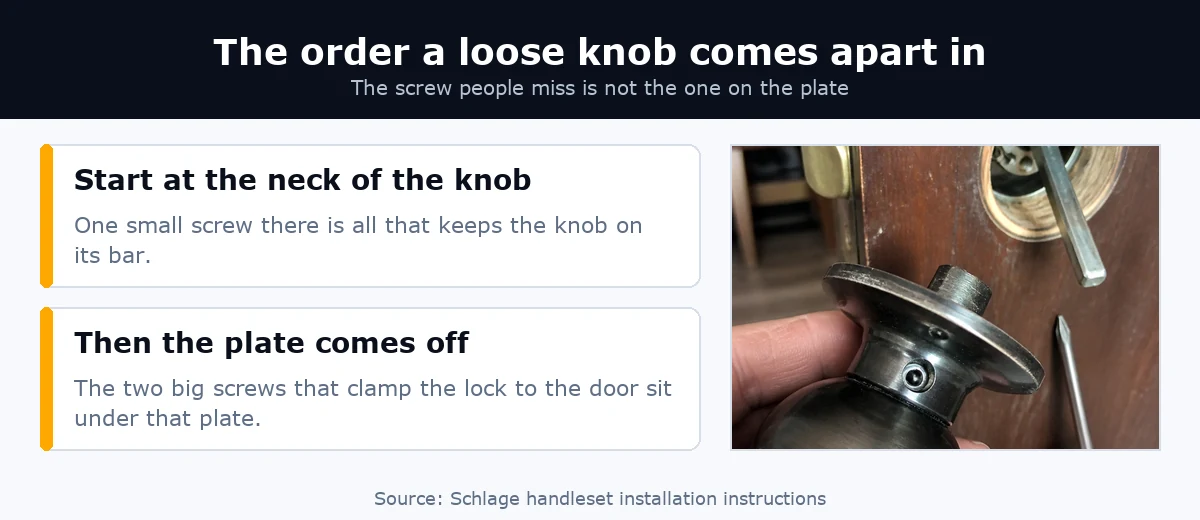
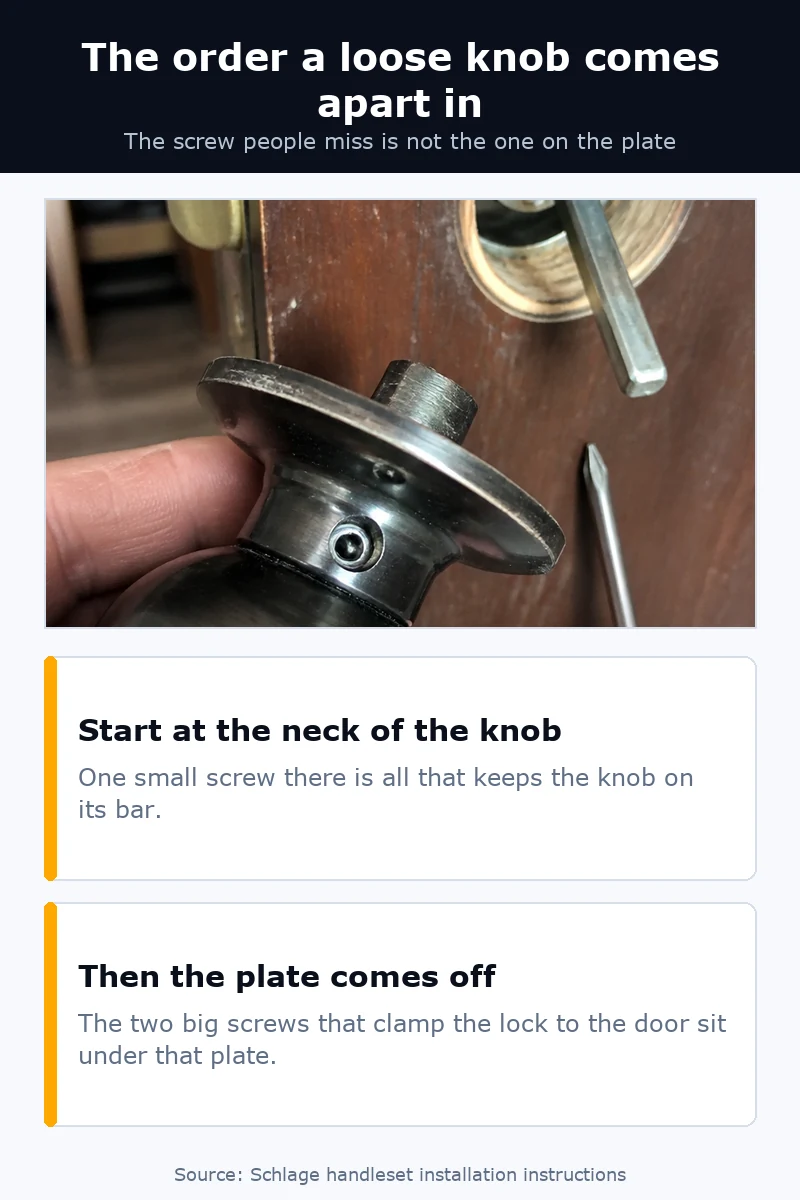
Newer knobs hide the screws under the round plate, which the trade calls a rose. Nothing is missing. You just have to get that plate off first.
Here is the order it comes apart. Look at the neck of the knob, where it meets the plate, and find a small hole or a tiny slot. That is a set screw. Loosen it and the knob slides off the square bar it rides on. With the knob gone, the plate either twists off or pries off with a flathead, and the two mounting screws are underneath.
Schlage's own instructions describe the same steps from the other direction. The sheet for its handlesets says to push the knob or lever firmly into place and then tighten the set screw, and to loosen that same set screw without removing it when a lever has to come off. So when a knob is sliding on its bar, that one small screw is the whole repair, and it takes a hex key more often than a screwdriver.
Then there is the door most people in this city actually have, where none of the above is true.
Why a city apartment door is a different job
Older apartment buildings here run mortise locks. Instead of a knob clamped through a round hole, there is a steel box buried in the edge of the door, and the knobs feed into it on a square bar. Pry at the plate on one of those and you will find no mounting screws behind it, because there are none.
Schlage builds the same style of lock for commercial doors, and its install sheet walks through the difference. The inside rose sits over a mounting plate, the knob bushing threads onto that plate, and the instruction is to tighten the bushing with a spanner wrench that ships in the box. A spanner wrench is a small two pronged tool that grips two holes in the ring. Nobody has one in a kitchen drawer, which is why a loose mortise knob usually ends in a phone call rather than a home repair.
There is a second reason to make the call rather than the repair. Section 27-2043 of the Housing Maintenance Code says an apartment entrance door in a class A multiple dwelling has to carry a heavy duty latch set and a heavy duty deadbolt, and Section 27-2005 says the owner keeps the building in good repair. Put those two together and the entrance lock is the landlord's equipment and the landlord's repair. Your bedroom door is a different story, and that one is usually on you.
Why it comes loose again a week later
Here is the part that saves you doing this twice. A knob that loosens once is normal wear. A knob that loosens every few weeks is telling you the screws have nothing left to grip.
Picture what happens each time somebody pulls the door shut by the knob. That pull works the screw back and forth a tiny amount in its hole. Do that a few thousand times in an old softwood door and the hole goes from a snug thread to a smooth tunnel. The screw still turns. It simply is not holding anything anymore.
Give the screw new wood to bite into. Squeeze wood glue into the hole, push in a few toothpicks or a golf tee, snap them off flush, and let the glue dry before the screw goes back in. Going up to a fatter screw feels faster and splits the wood that is left, which is how a five minute job turns into a repair with a drill in it.
3 things I check before anybody buys a new lock
When one of my technicians looks at a knob, this is the order. You can run the same three at home in about a minute.
- Does the latch pull all the way back when you turn the knob? Open the door and watch the edge while somebody turns it. A latch that only comes halfway means the worn part is inside the lock, and no amount of tightening reaches it.
- Are the screws the ones that came with the lock? Mounting screws are cut for a door of a certain thickness. Somebody who lost one and grabbed a longer screw out of a jar ends up with a screw that bottoms out before it ever pulls the two halves together, so the knob stays loose no matter how hard you turn the screwdriver.
- Does the door still line up with the frame? A door that dropped on its hinges makes people yank the knob harder every day, and that yanking is what loosens it. Fix the hinge screws and the knob stops coming undone.
One of those three answers usually changes the plan, and the first one is the answer that matters most.
When a loose knob turns into a door that will not latch
A wobbly knob on a closet is an annoyance. The same wobble on an apartment entrance door is worth treating as a small emergency, for one reason.
Follow what happens when the parts inside get worn. You turn the knob and the square bar turns. The bar pulls the latch back into the door. When the bar is rounded off, the knob turns and the latch comes back part way, or not at all. Now the door closes against the frame and bounces back open instead of catching, and the apartment door in the hallway of a New York building is a fire door that is supposed to shut and stay shut.
So if your entrance door has started drifting open on its own, the latch is no longer catching. It is the same door your building has to keep self closing and latching, and getting it back to closing properly is a same week job, not a someday job.
FAQ
My knob is tight but the door still rattles when it is shut. Same problem?
Different problem, and the fix is cheaper. A rattle with a tight knob means the latch has room to move inside the hole in the frame. Most strike plates have a metal tab you can bend in slightly to take up that gap, and some have an adjustable one you move with a screw. Nothing about the knob needs touching.
Can I just put a new knob on instead of fixing this one?
On an interior door, yes, and a basic knob costs less than most service calls. Measure two things first: how far the center of the hole sits from the edge of the door, and how thick the door is. On an apartment entrance door, stop there and ask your building, because that lock is the landlord's equipment and swapping it can put you in the wrong.
The knob came off in my hand and the door is shut. Am I stuck?
Usually not. Look into the hole where the knob was and you will see the square bar that runs through the door. That bar is what pulls the latch back, so turning it with pliers or pushing it with a screwdriver opens the door. What does strand people is the bar falling out on the other side, and there is no fixing that from your side of a shut door.
Is a lever better than a knob if this keeps happening?
Levers are easier on hands and wrists, which is the real reason to switch. They do not stay tight any longer than knobs do. Levers actually put more weight on the same small screws, so a lever on a stripped hole comes loose sooner. Fix the hole either way, then pick whichever shape you like.
Who pays for this in a rental?
In a New York City apartment the lock on the entrance door is the owner's to provide and to keep working, so a failing entrance lock is a repair request, not your errand. Inside your apartment, a bedroom or closet knob is a gray area that most leases put on the tenant. Put the request in writing either way, because a dated email is what settles it later.
Want Somebody to Look at That Door?
We work on apartment and house doors across Manhattan, Brooklyn, Queens, the Bronx and Staten Island, and a knob that spins without moving the latch is a same day job for us. Call (646) 781-7070 or send us a photo of the knob and the door edge, and we will tell you whether it is a screw or a lock.