

Something on your door needs fixing, and before anybody can price it you have to say what kind of lock is on it. Most people cannot, and that is fair. Two very different locks look about the same from the hallway.
A mortise lock is the kind that lives inside the door. Somebody cut a deep rectangular pocket into the edge of the door, and a steel box holding the latch and the deadbolt sits in it. That pocket is the mortise, an old woodworking word for a cavity cut to hold another part. Most pre-war apartment, co-op and brownstone doors in New York have one.
You want to know whether your door has one, which part has gone wrong, and whether it can be fixed without a whole new lock. A mortise lock repair is usually smaller than people expect.
By the end you will know how to spot one in ten seconds, its five parts, which part your problem points to, what rekeying involves, and the two measurements a replacement must match.
I am Roye Gvili. I run Top Notch Locksmith & Security out of Manhattan, working on apartment, co-op and storefront doors in all five boroughs, including the hardware the city requires.
Key takeaways
- On a mortise lock the keyed part is a separate brass cylinder that unscrews out of the lock body, so changing your key is a small job rather than a new lockset.
- Mortise locks come in two backsets, the distance from the edge of the door in to the middle of the keyhole: 2-1/2 inch and 2-3/4 inch. Order the wrong one and none of the holes in your door line up.
- A loose knob, a key that will not turn and a door that will not latch are three different parts of a mortise lock, so one failing does not mean the whole lock is finished.
- If your apartment entrance door carries a fire label on its hinge edge, the lockset on it has to be tested for use on fire doors, which rules out most hardware-store sets.
What is a mortise lock?
A mortise lock is a lock whose working parts sit in a steel case inside a pocket cut into the edge of the door, instead of in round holes bored through the face of it.
- That case, called the lock body, holds a spring latch and usually a deadbolt in one unit.
- From the hallway a key turns a cylinder screwed into the case, and inside you turn a thumbturn.
- The long thin plate on the door edge is the front of that case.
Where that comes from: the makers sell it in pieces. Marks USA, whose locksets are on many New York apartment doors, lists body, trim and cylinder as separate items, in two backsets.
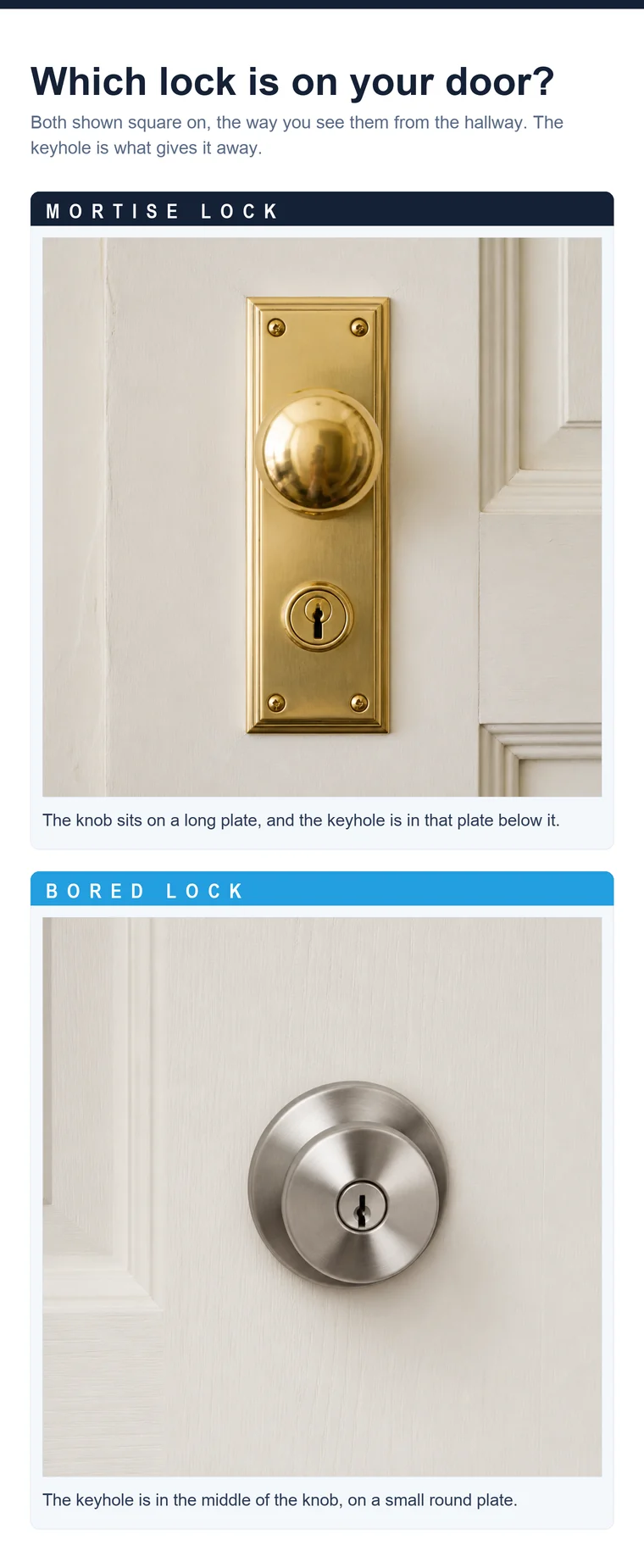
The other kind is the bored or cylindrical lock, named for the round holes it needs through the door face. Set a mortise lock vs cylindrical lock side by side and the only difference is how the door was cut. Mortise locks turn up on pre-war buildings and storefronts, bored locks on newer homes.
How to tell if your door has a mortise lock
Open the door and look at its edge. Three things answer it, and none needs a tool.
- One long plate on the door edge. Several inches tall, a screw at each end, with latch and deadbolt both coming out of it. A bored lock has a small one.
- The keyhole sits outside the knob, in its own round barrel above or below it. A key going into the middle of the knob means a bored lock.
- A long upright plate behind the knob, running past the keyhole, where a bored lock has a small round collar.
The five parts, and which one is actually broken
A mortise lock is five parts that come apart from each other. The body is the steel case in the door, and the cylinder is the keyed barrel screwed into it. The trim is the knob and its plate on a square spindle. The faceplate sits on the door edge, and the strike is the lined hole in the frame.
So your symptom points at one of them.
| What you notice | The part behind it | What it usually takes |
|---|---|---|
| The key is hard to turn, or will not turn | The cylinder | A cylinder, not a lockset |
| The knob turns but the latch does not move | Inside the body, or the spindle | The body comes out and gets opened |
| The knob wobbles and keeps coming loose | The trim and the spindle | New trim screws, or new trim |
| The deadbolt will not go all the way out | The strike in the frame | The strike gets moved, not the lock |
| The door only latches if you pull it toward you | The door and the frame | Hinges, or the arm that pulls the door shut |
Two have posts of their own: a loose knob and a door that will not latch.
Rekeying a mortise lock: the cylinder comes out, the body stays
When somebody moves in, or keys go missing, the cylinder is the part that changes. Back off the small screw behind the faceplate and it unscrews out of the body, leaving the pocket in your door untouched.
In a building that saves money. A mortise body takes most brands of cylinder, because the cam, the flat tongue pushing the bolt, is all that has to match. Marks ships cams to suit Corbin, Sargent and Schlage cylinders. For a super with twenty doors that is twenty cylinders rather than twenty locksets.
The two numbers that decide whether a new lock fits
Sometimes the body really is finished, and two measurements then decide what replaces it. The first is the backset. Marks USA sells its locksets in 2-1/2 inch and 2-3/4 inch backsets, 2-3/4 inch being the usual commercial size. Order the wrong one and no hole in the trim lines up.
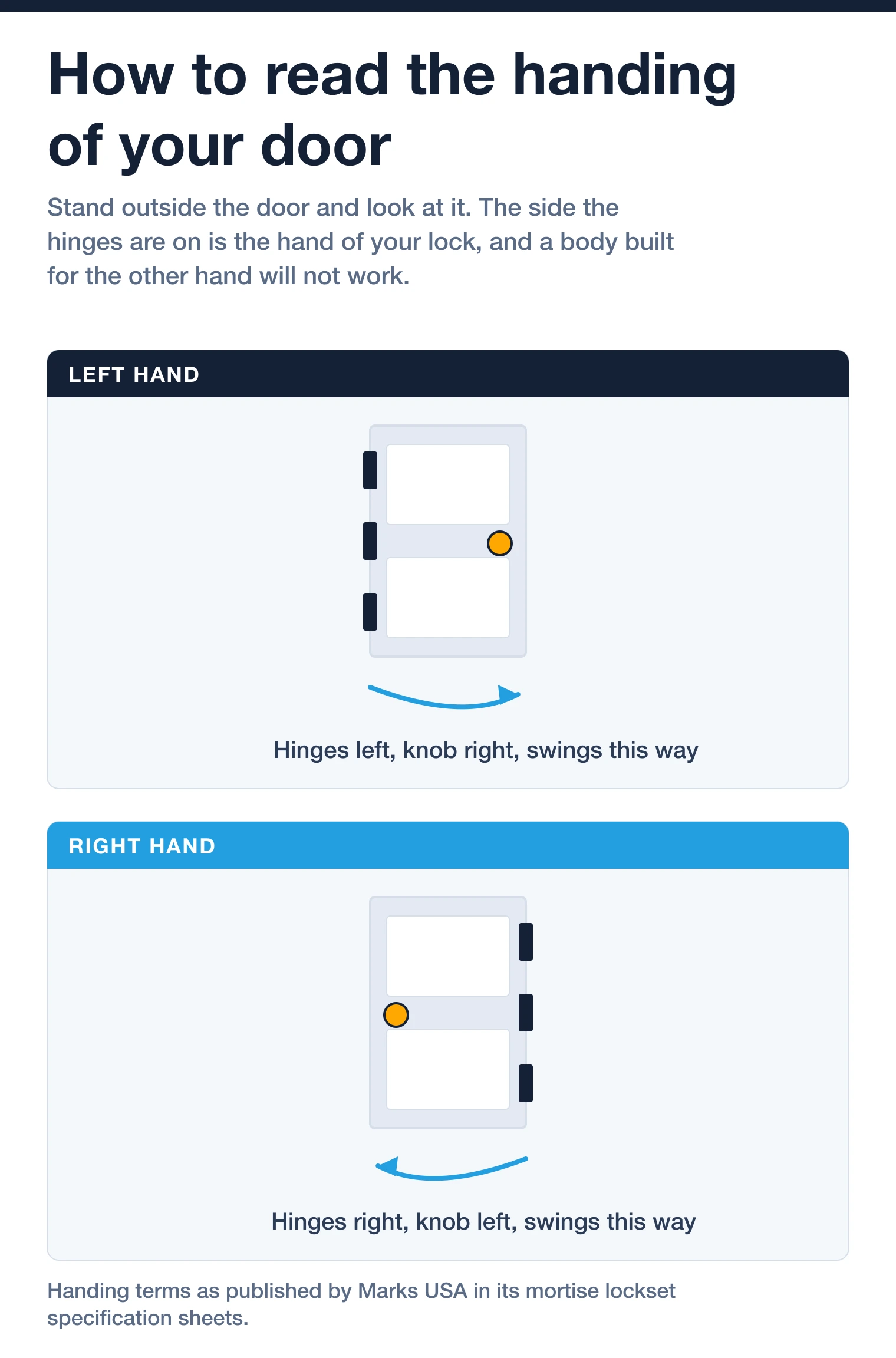
The second is handing, the side of the door the lock is built for. Better bodies turn around, like the Marks lockset whose spec sheet says handing is completely reversible without opening the lock case. Older ones are not, so this gets settled before anybody orders.
What a mortise lock has to do on a New York apartment door
On an apartment entrance door the lockset does a particular job. A key from the hallway locks the outside knob and throws the deadbolt, and inside you turn a thumbturn. The spec sheets put the important half plainly: the inside is always free for egress, so you get out without a key. A lock needing a key inside is not allowed on an apartment door here.
Hardware on a fire labeled door has to be tested for it, and Marks states its locksets UL listed, which means the lab Underwriters Laboratories tested them, and 3 hour fire rated. On a shared door one more rule applies: the federal accessibility standards, section 404.2.7, say the handle, latch and lock sit 34 to 48 inches off the floor and work without a tight grip. A set bought online can fail that and still fit the pocket.
New York doors often carry two locks. A boxy second one on the inside face of the door is a jimmy-proof, not a mortise, and we compared those two here.
What you get when we work on one
Mortise jobs go wrong in the ordering, not the labor, so that is where our care goes.
- Every mortise lock installation starts with the measurements. Backset and handing before ordering, so nobody pays twice.
- We try the cylinder first. If the key is the problem, you buy a cylinder.
- Our van carries full mortise lock bodies for pre-war and storefront doors.
- A labeled door keeps tested hardware. On a fire rated door we fit a listed part.
Frequently Asked Questions
Can I buy a mortise lock at a hardware store?
Rarely the right one. A hardware store stocks the bored kind, because that is what newer doors take. A mortise lockset has to match the pocket already cut in your door: the right backset, the right handing, and trim with holes in the same places. That is why a set bought on a guess goes back in the box.
What is a mortise cylinder, and is it the same as the key?
The cylinder is the small brass barrel the key goes into. It is threaded like a bolt and screws into the lock case. Cylinders come in several lengths for different door thicknesses, so one sticking out past the trim is the wrong length rather than a broken part.
How long is a mortise lock supposed to last?
Decades, and that is not a number I am guessing at. Mortise locks are tested against the industry standard ANSI/BHMA A156.13, and the Builders Hardware Manufacturers Association says a Grade 1 lock has to survive 1,000,000 cycles of opening and closing with a 10 pound load applied. It is one reason old New York doors still carry their original bodies.
Can I put a smart lock on a mortise door?
Not the keypad deadbolts sold in boxes, because those need round holes bored through the door. What fits is a lockset built for a mortise pocket, which costs more. In a rental or a co-op, read what a rental apartment allows and ask management first.
Not Sure What Lock Is on Your Door?
Photograph the edge of the door and the knob, and send both over. We will tell you whether it is a mortise lock and which part is at fault. We cover Manhattan, Brooklyn, Queens, the Bronx and Staten Island, around the clock. Call (646) 781-7070 or use our contact page.