

A door strike plate is the small metal plate on the door frame, and it is the reason a door shuts and locks properly. When you turn the key, a metal bar slides out of the door. That bar is the bolt, and it has to drop cleanly into the hole in that plate. If you leave that plate loose, a three hundred dollar lock still lets the door shift, and the longer it stays loose the more of the frame breaks up around the screws. If you leave it long enough, a five dollar plate turns into a frame repair. That means a carpenter and a day rather than a screwdriver and ten minutes.
Every guide answers the same way: longer plate, longer screws into the framing. That is right in a house. Most New York apartment doors hang in a steel frame, where those screws reach nothing but hollow space, so the answer starts with your frame rather than with the plate.
By the end you will know which of the four plates your lock needs, what your frame is made of, what to do when the screws spin instead of tightening, how long the screws should be and the one door where longer is wrong, and what a tenant may change on a door the city has rules about.
I am Roye Gvili, and I run Top Notch Locksmith & Security out of Manhattan. This is the part we get called out to most, nearly always for a door that stopped shutting properly.
Key takeaways
- Screws that spin in their holes are the common failure, not a forced door. On a wood frame the repair is the hole: fill it, let the glue dry, drill it fresh.
- Three inch screws only help on a wood frame, and Schlage warns they are too long where a window sits beside the lock.
- A steel apartment frame takes machine screws turned into threads cut in the steel, so a longer wood screw does nothing there.
- New York tenants may add one lock of their own, and a fire rated frame may not be cut without written permission from the lab that listed it.
Which strike plate does your door need?
Start with the lock you already have, because the lock picks the plate rather than the other way round. There are only four to choose between, and a hardware store carries all of them.
Four plates cover almost every door, and the lock on the door picks one of them.
- A small plate with a curved lip, for the sloped catch that clicks shut on its own when you push the door. This is the one in the box with a new handle.
- A deadbolt plate, the same idea with a bigger hole and often a steel cup behind it so the bolt is wrapped on three sides. That cup is a box strike.
- A security strike plate, which is a longer, thicker version of either one, with four or six screw holes instead of two.
- A tall plate with two holes, for a mortise lock. That is a lock sitting in a pocket cut into the edge of the door. An old vertical jimmy proof lock takes a surface bracket instead.
Where that comes from: Schlage ships a steel box and a frame reinforcer with its commercial deadbolt. Don-Jo, which makes much of this hardware for American buildings, lists the plate sizes that match a frame.
Here is what separates the security version from the plate in the box. A standard plate bends in your hands, while Don-Jo builds its deadbolt security strike from 13 gauge steel, a little under a tenth of an inch. Length matters even more. A longer plate puts its screws further apart up and down the frame, so a kick has to split a bigger piece of wood than the two inches between two screws.
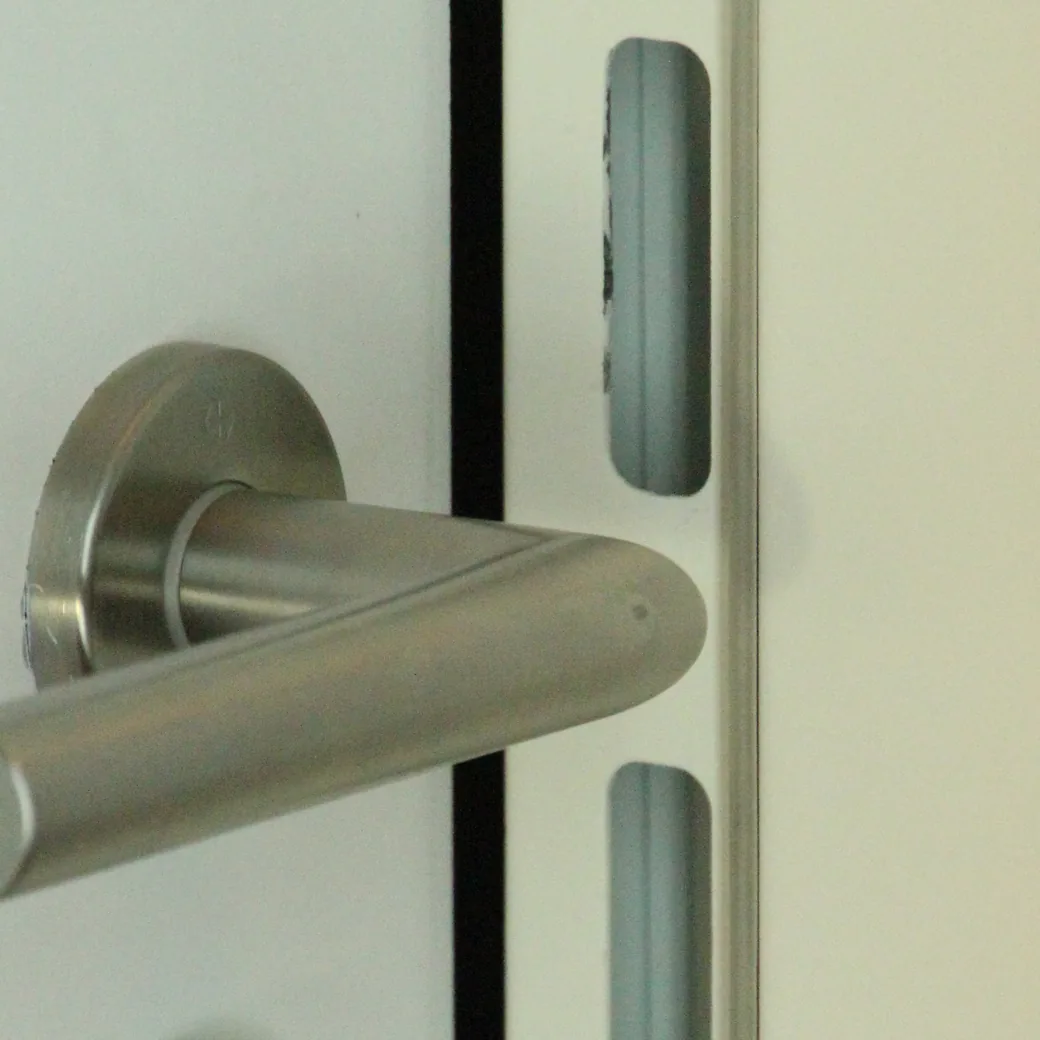
Your frame decides what will actually hold
Now you know which plate you are shopping for. What decides whether it holds is the thing behind it, and this is where most advice stops being true in New York. Frames come in three kinds in this city, and each takes a different fastener, which is just the screw or bolt doing the holding.
| What your frame is | What holds the plate | Where you see it |
|---|---|---|
| Wood, with a wall stud behind it | Long wood screws, through the frame into the framing | Houses, brownstones, interior apartment doors |
| Hollow steel, pressed in one piece | Machine screws turned into threads cut in the steel | Apartment entrance doors, stairs, offices |
| Aluminum, around a glass door | The lock maker's own strike, sized to that frame | Storefronts and lobby doors |
Steel frames are the ones that surprise people. The frame is pressed from sheet steel and is hollow inside. Behind the plate sits a separate piece of steel with screw threads cut straight into it. The trade practice for that work, in the Steel Door Institute's own guidance, asks the installer to confirm those cut threads hold at least 65 percent of a full thread. What holds the screw is those threads, not the length of it. A long screw turned into a hollow frame catches the same few threads the short one did, and the rest of it hangs in the empty space behind the steel.
Aluminum storefront frames are narrower still. A glass door has a deadlatch, the narrow lock that catches by itself when the door swings shut, and it takes its own maker's plate. That is why a storefront door lock job is a parts order, not a hardware store trip.
When the screws just spin in the hole
So much for the right plate on the right frame. The part that surprises people is that the plate is rarely what failed in the first place. Spinning screws are the failure we get called for most, and no burglar is involved. The two screws holding a standard plate are short enough to stop in the soft board the frame is made from. Every pull on the handle loosens them a little, the wood crumbles, and one day they turn forever without tightening. The plate slides down, the latch catches on it, and the door needs a shove.
Here is how that hole gets fixed, in the order it happens. On a wood frame the repair is the hole, not the screw. Take the plate off, squeeze glue into the ruined hole, pack it with a hardwood dowel or a few wooden toothpicks, and snap them off flush. Let the glue dry, drill a fresh pilot hole through the middle, then put the screw back in. A bigger screw jammed into a crumbling hole splits the frame instead.
On a steel frame nothing crumbles, because the threads are cut into the steel. A screw that spins there has stripped those threads, so the fix is the next screw size up, never a wood screw forced in. If the plate still moves with a sound screw in it, the door has probably dropped.
The three inch screw, and the one place it is wrong
Now you know how to make a hole hold again. The next question is how long the screw going into it should be, and there is one door in this city where the usual answer is wrong. On a wood frame long screws are the cheapest thing you can do to a door. Schlage, which makes the deadbolt on a lot of New York doors, sells a reinforcement plate with three inch screws and says they add impact resistance.
One door is the exception, and Schlage names it in the same breath. Where a window runs down the frame beside the lock, called a sidelight, those screws may be too long to use, because there is glass behind the frame instead of framing. Brownstone entrances and lobby doors in this city are full of them.
Drill a pilot hole first, which means a narrow guide hole for the screw to follow, or a long screw splits the frame on the way in and the door ends up weaker than it was. And if the frame is already cracked, a new plate over the crack covers it up instead of fixing it. That frame needs the broken piece cut out and replaced first.
How deep the hole behind the plate has to be
Get all of that right and the door can still feel wrong, because the plate is only half the job. Behind the hole sits a pocket drilled into the frame, and the bolt needs that pocket empty and deep enough to come all the way out, because a bolt stopped halfway holds about as well as a latch. Schlage builds its commercial deadbolt with a one inch throw, which is how far the bolt comes out of the door.
Check it with the door open. Turn the key and see how far the bolt comes past the edge of the door, then shut the door and turn the key again. If it feels tight, or stops short, the pocket is too shallow or the plate sits too high or too low over it. A chisel and ten minutes of cleaning out that pocket is often the whole repair.
What a New York tenant is allowed to change
All of that assumes the door is yours to work on. If you rent, what happens if you drill the frame without asking is a fair question, and the answer has two halves. Renters are allowed more than most of them think, up to one hard limit. State law gives a tenant in a multiple dwelling the right to install one lock of their own, no more than three inches in circumference, in addition to the landlord's lock, with a duplicate key handed over if the owner asks for one. A lease clause charging you for that is void. Swapping the strike plate that serves the landlord's lock is a different thing, so ask the super or the managing agent before you take a drill to the frame, and know what the owner may and may not do to the same door.
Here is what the fire label does to all of this. Apartment entrance doors carry one, and it is the hard limit on anything you cut. They are usually fire rated assemblies, meaning the door, the frame and the hardware were tested together and carry a label to prove it. The Steel Door Institute puts the rule plainly: a change to a listed frame out in the field goes back through the manufacturer to the laboratory that listed it, and may only be performed on written authorization from that laboratory. If you cut that frame for a longer plate on a Saturday, the building can lose its rating at the next inspection. The fix on those doors is a plate that fits the cutout already there.
What you get when we fit one
Ask for these three things on any strike plate job, ours or anybody's.
- We take the old plate off and look behind it first, because a split frame and a weak plate are two different repairs.
- We match the plate to the frame material, and on an apartment door we read the fire label, which the Steel Door Institute says sits on the hinge side of the frame.
- We turn the key with the door open and again with it shut before we leave, so the bolt reaches full travel instead of catching on the new plate.
Frequently Asked Questions
Four more things people ask once they are at the frame with a screwdriver in hand.
What size strike plate do I need?
Measure the one you are taking off. Houses use a small plate: Schlage ships its deadbolt with a strike 2-3/4 inches tall. Apartment and office buildings use a taller one, 4-7/8 inches by 1-1/4 inches, because that is the shape the steel frame was punched for at the factory. Buy that size and the new plate drops into the old cutout.
Can a new strike plate fix a door that will not latch?
Sometimes, and it is worth checking before you buy anything. A door that misses the hole is usually sitting too low, or sticking out past the frame, which is a different repair. We went through that one in a separate walkthrough, and the test takes a minute.
Does a mortise lock use the same plate?
No. A mortise lock lives in a pocket cut into the edge of the door, common in pre-war New York buildings, and it fires two bolts at different heights. It needs one tall plate with two holes, sold as a T strike. Here is how to tell if your door has one before you shop.
What about the old vertical lock on my apartment door?
That one keeps its own hardware. A jimmy proof lock drops two steel pins into a bracket screwed to the face of the frame, so it uses no plate with a hole at all. The bracket and its screws are the whole strength of it, and we compared that lock with a deadbolt separately.
Door Not Latching, or Screws That Will Not Hold?
Send a photo of the open door beside its frame and we will tell you what plate it takes and whether the frame behind it is sound. We cover Manhattan and all five boroughs around the clock for lock and hardware installation. Call (646) 781-7070 or use our contact page.