
Your landlord can change the lock on your apartment door in New York City, but only if you get a key to the new lock, or if a city marshal or sheriff carries out an eviction order signed by a judge. A new lock with no key for you is an illegal lockout, and state law makes that a class A misdemeanor. It does not matter whether you are behind on rent, whether your lease ran out, or whether your name is on the lease at all. Most of the lock change and apartment lockout calls we take from renters start with that one question.
I am Roye Gvili. I started Top Notch Locksmith & Security in Manhattan in 2010, and my technicians work on apartment doors in all five boroughs every day. This question comes up in August and September more than any other time of year, because that is when leases turn over and landlord disputes come to a head. By the end you will know when a lock change is legal, what the law counts as an illegal lockout, the five things to do in the first day if you come home to a new lock, whether you can put your own lock on the door, and what a licensed locksmith will ask you for before touching it.
This is general information, not legal advice. It comes from the statutes and city sources linked below and from the apartment calls my team runs. Your lease, your house rules, and your own facts can change the answer, so read your lease and talk to a tenant attorney or a free legal service provider about your case.
Key takeaways
- A lock change is legal when you get a key, or when a marshal or sheriff carries out a court eviction order.
- Section 768 of the Real Property Actions and Proceedings Law protects anyone with a lease and anyone who has lived there 30 days or more.
- An illegal lockout is a class A misdemeanor, and the civil penalty runs $1,000 to $10,000 per violation.
- Call 911 first, then 311 for the Tenant Helpline, then Housing Court the same day.
- Multiple Dwelling Law 51-c lets you add your own lock, and you owe the landlord a duplicate key on request.
When Can a NYC Landlord Legally Change Your Locks?
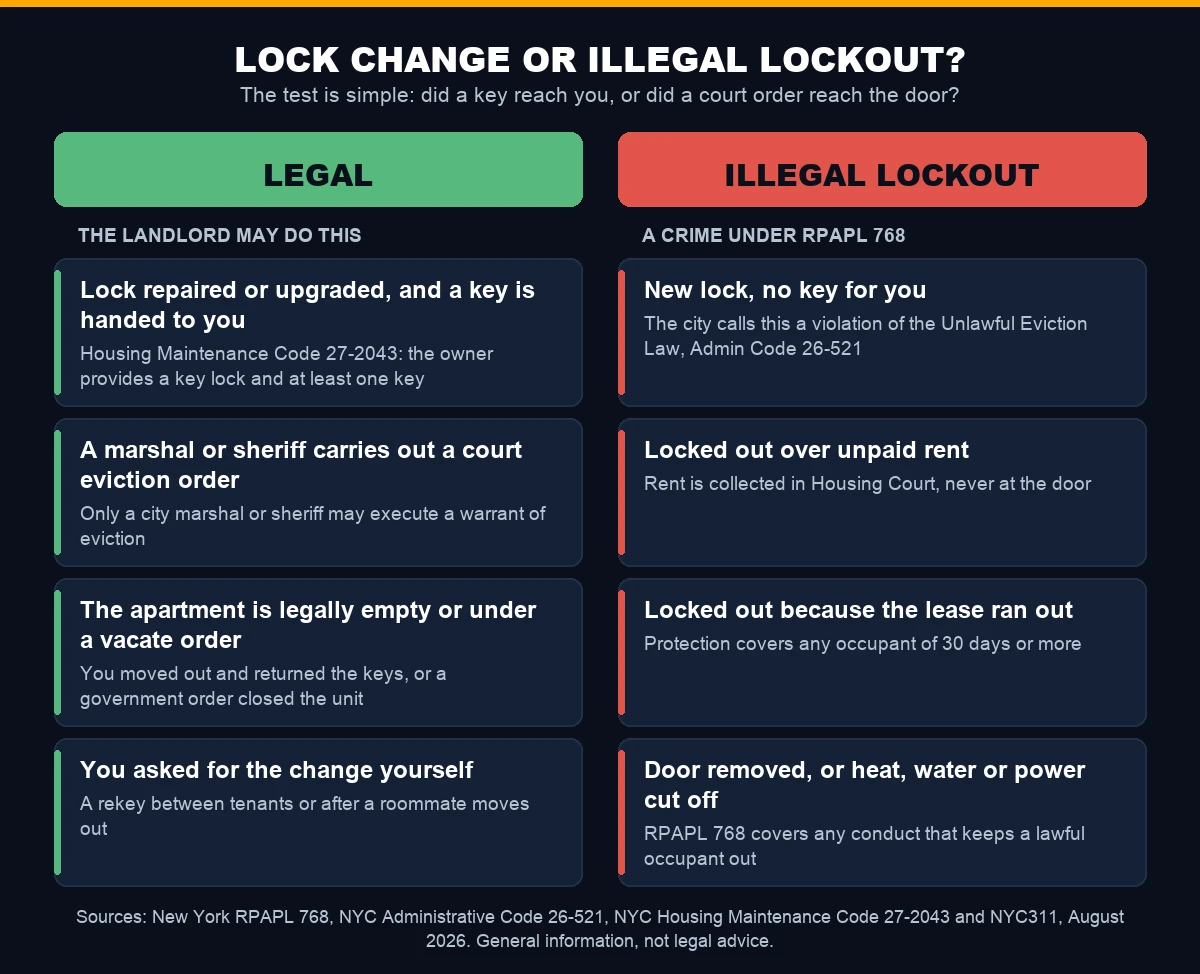
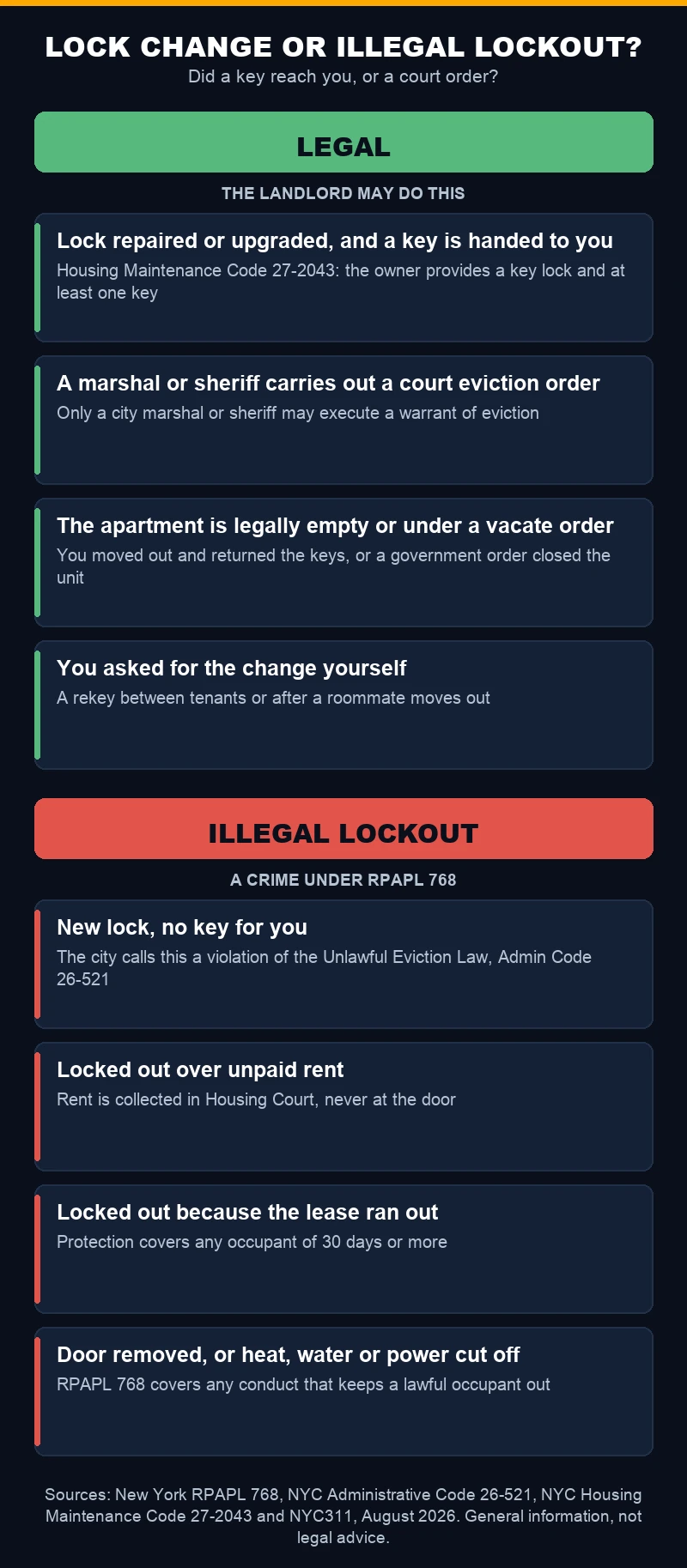
There are four situations where a new lock on your door is fine. In every one of them, either the key ends up in your hand or a court already ended your tenancy.
- The lock broke or is being upgraded, and you get a key. Section 27-2043 of the New York City Housing Maintenance Code says the owner has to provide a key lock in the entrance door of each apartment and at least one key. In a class A multiple dwelling that door also needs a heavy duty latch set, a heavy duty deadbolt worked by a key outside and a thumb-turn inside, and a chain door guard. We go through all of the NYC apartment door lock requirements, including the peephole and the self-closing rule, in a separate post.
- A marshal or sheriff carried out an eviction order. According to NYC311, only a city marshal or sheriff may carry out a warrant of eviction. Papers from your landlord, a letter, or a court date are not an eviction.
- The apartment is legally empty. You moved out and handed back the keys. Or a government vacate order closed the unit.
- You asked for it. Plenty of owners rekey between tenants, and plenty of tenants ask for a fresh cylinder after a roommate leaves.
One more thing comes up in the same argument, and it is not a lock change. Your landlord may enter your apartment without notice in an emergency. For repairs, services, or showings, entry happens at a reasonable time with notice, according to the Department of Housing Preservation and Development. Entry is not the same as taking the apartment back.
What Counts as an Illegal Lockout, and Who Is Protected
An illegal lockout is any move that shuts you out of your home without a court order. Section 768 of the Real Property Actions and Proceedings Law came in with the Housing Stability and Tenant Protection Act of 2019. It makes it unlawful to use force, cut off essential services, or do anything else that keeps a lawful occupant out. The city version is Administrative Code section 26-521, and the Department of Housing Preservation and Development states plainly that changing the locks without giving the resident a key violates that law when the landlord has no warrant of eviction.
Two numbers matter here.
- 30 days. The law covers anyone with a written or oral lease, and anyone who has lawfully lived in the unit for 30 days or more. Guidance the New York Attorney General sent to police departments on May 4, 2020 names who that catches. Tenants whose leases expired. Family members. Roommates and other occupants who have been there at least 30 days, whether or not they ever paid the landlord directly.
- $1,000 to $10,000. That is the civil penalty per violation under section 768, on top of a class A misdemeanor charge. Add up to $100 a day, for as long as six months, if the occupant is not put back in. The statute reaches "any person who intentionally violates or assists in the violation." A managing agent or a contractor is exposed too, not only the owner.
This happens more than people think and gets punished less than people think. The New York City Council data page on unlawful evictions counted 1,814 illegal lockout cases in Housing Court for the year from August 2024 to August 2025. Police wrote 54 criminal court summonses for illegal eviction in the same year. Tenants are the ones filing, so the paperwork you keep decides how fast you get back in.
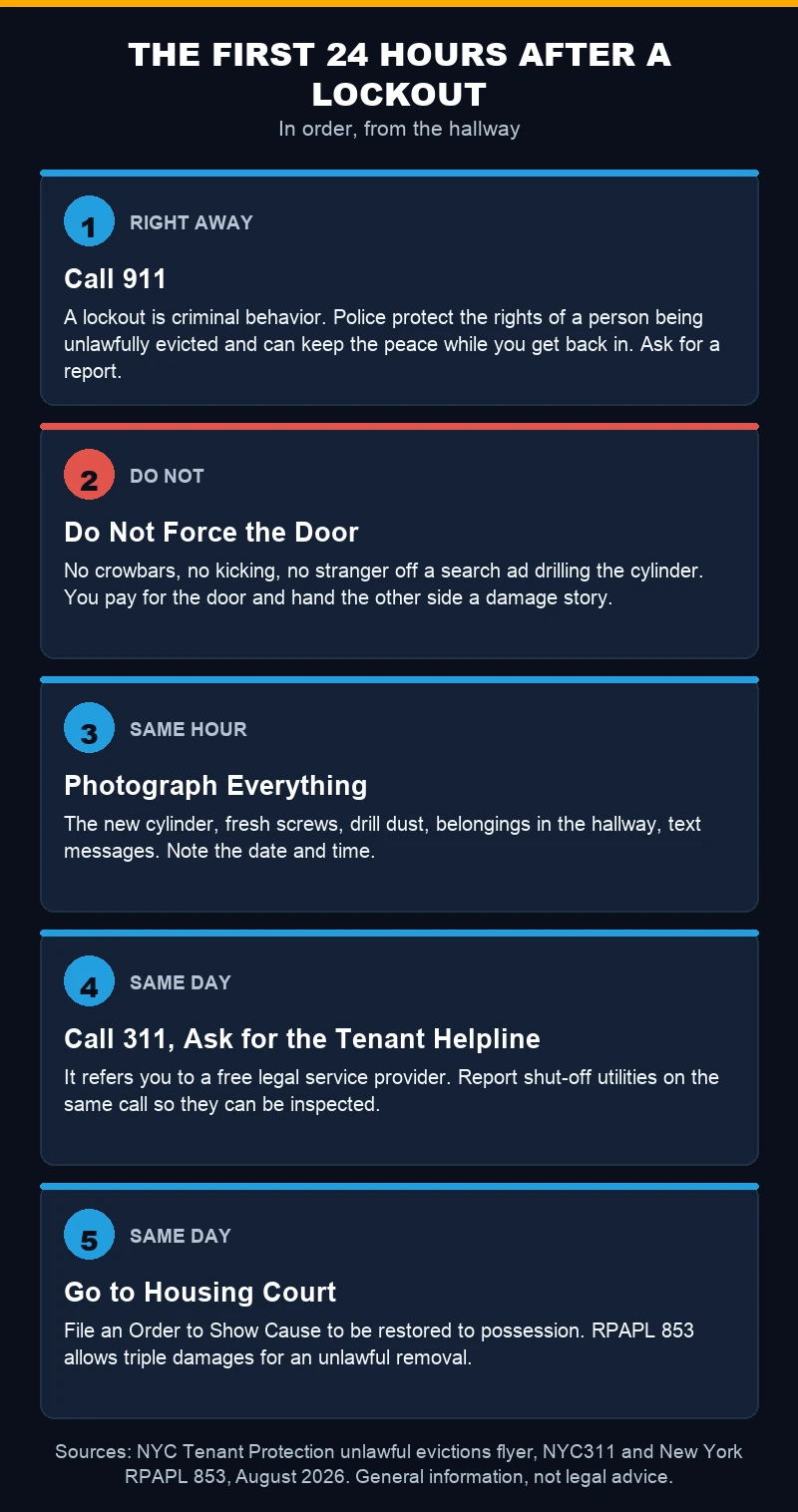
5 Things to Do in the First 24 Hours If Your Landlord Changed the Locks
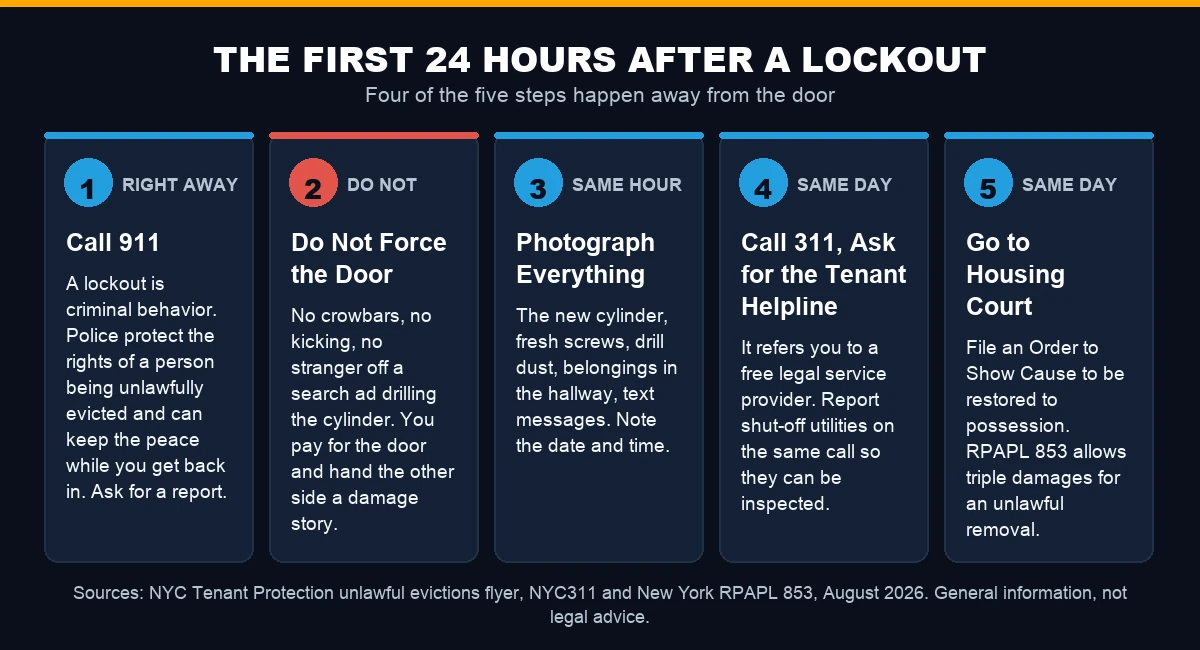
This is the order I give people when they call us from the hallway. The first four steps cost nothing, and none of them involve the door.
- Call 911 right away. The city's own tenant rights flyer calls a lockout criminal behavior. It says the police protect the rights of someone being unlawfully evicted, and that officers can keep the peace while you take steps to get back in. Ask for a report.
- Do not force the door. No crowbars, no kicking, no calling a stranger off a search ad to drill the cylinder. You will pay for the door, and you hand the other side a story about property damage.
- Photograph everything. The new cylinder, shiny screws, fresh drill dust on the floor, your belongings in the hallway, any text messages. Add the date and time.
- Call 311 and ask for the Tenant Helpline. It refers you to a free legal service provider. Same call, ask for the agency if utilities were shut off, because that is inspected and can draw a violation.
- Go to Housing Court in your borough the same day. You file an Order to Show Cause to be restored to possession. The case is brought under section 853 of the Real Property Actions and Proceedings Law. That section lets a person put out of a home in an unlawful manner recover triple damages.
The Papers That Prove the Apartment Is Yours
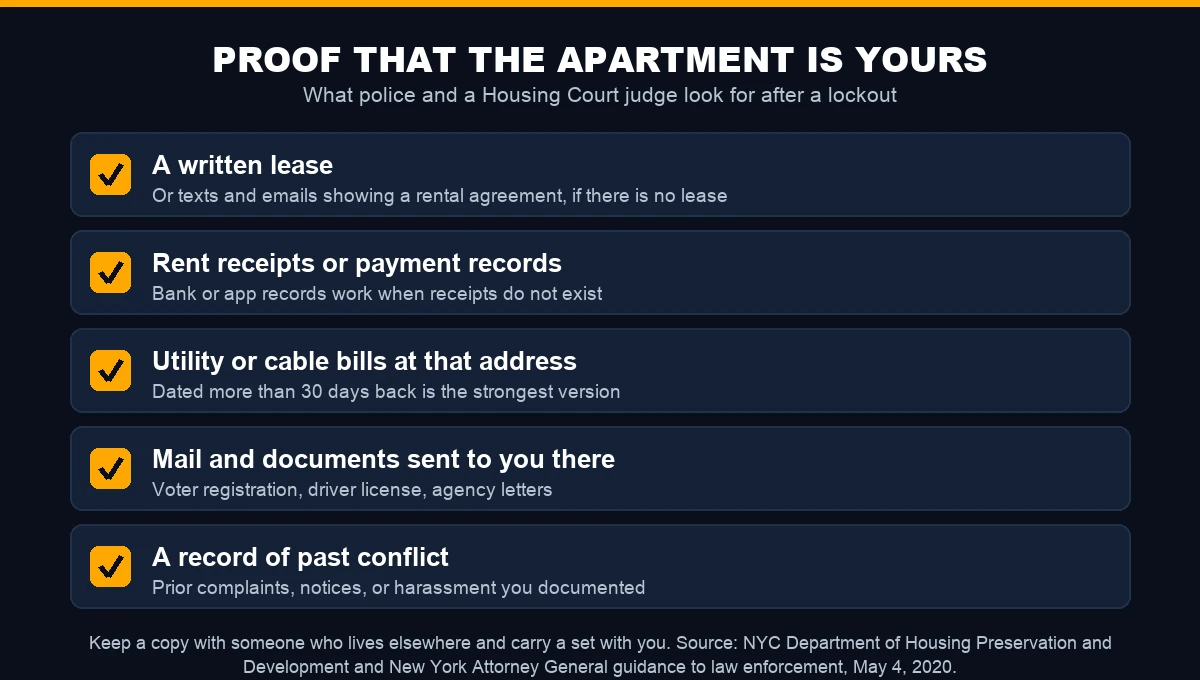
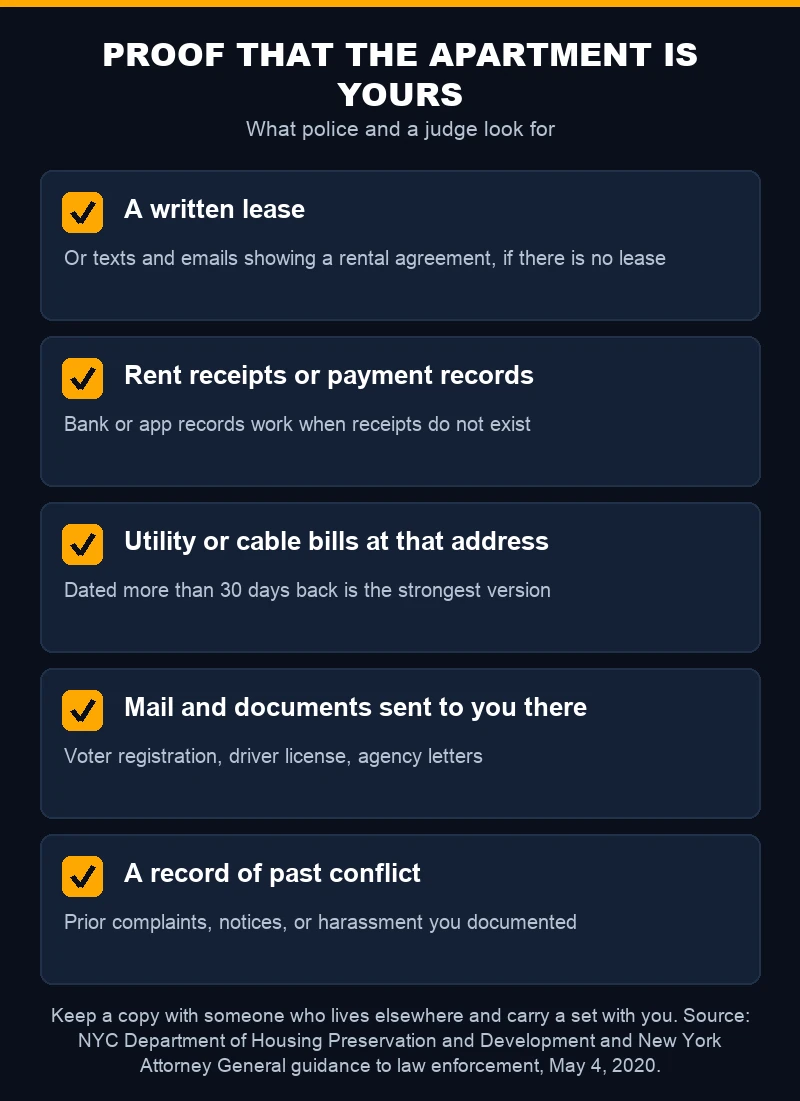
Police and a judge both work from proof that you live there. The housing agency lists what helps. A lease. Rent receipts. Utility or cable bills at that address. Mail or documents sent to you there. Any record of past conflict with the landlord. The agency adds the part people miss. Most of those papers live inside the apartment you cannot get into, so leave copies with a friend or a relative who lives somewhere else, and carry a set with you.
If you do not have traditional paperwork, you are still protected. The Attorney General guidance tells officers that missing documents should not be a barrier, and that text messages, emails, or proof of rent payments can show a rental agreement exists.
Can You Change Your Own Locks as a Renter?
Yes, within limits. Section 51-c of the New York Multiple Dwelling Law lets a tenant install one lock of their own, no more than three inches in circumference, separate from the lock the owner installs and keeps up. A lease clause charging you a fee for that right is void. The trade-off is the key: the statute says a duplicate goes to the landlord or the agent on request, and the housing agency states the same rule for a tenant who changes locks.
So a renter can add security without a fight, but nobody gets to lock the other side out permanently. If you are deciding what that one lock should be, we put the two usual choices side by side in jimmy-proof lock against deadbolt. Three practical notes from our jobs:
- A rekey is usually enough. If you just want the old keys dead, changing the pins inside the lock does that. No new hardware needed. We cover the timing in rekeying after a move, and the mechanics in apartment rekeying.
- Electronic locks have their own rules. A code or an app does not remove the duplicate key duty, and boards often say no. See smart locks in a NYC rental.
- Co-ops and condos add house rules. Buildings can require a specific cylinder or keyway, so ask the managing agent before you buy hardware.
What a Licensed Locksmith Will and Will Not Do
Section 768 says "any person" who assists in an unlawful eviction can be charged. That single phrase shapes how a legitimate shop answers the phone, and it is worth knowing before you call anyone.
- We ask who you are, every time. A lease, mail, a bill, an ID with that address. On a residential lockout we want the apartment tied to you before a tool comes out of the van.
- We do not change a lock on an occupied apartment because an owner says the tenant is gone. Gone means a court order carried out by a marshal or sheriff, or an apartment that is genuinely empty.
- We check the license question in reverse too. Locksmiths in this city need a Locksmith license from the New York City Department of Consumer and Worker Protection to service, install, or open locks. Ask for the number of whoever shows up at your door, whoever sent them.
- What we do handle: getting you back in once the apartment is shown to be yours, then a new cylinder or a rekey. We also add a second lock within the three inch rule, and we tell you which of those you actually need.
Top Notch Locksmith & Security is a licensed and insured locksmith and security company based in Manhattan, working on apartments, co-ops, condos, and commercial doors across the five boroughs of New York City. Lockouts, lock changes, rekeys, and high security cylinders are the daily work, so we see how these disputes end more often than any one tenant does.
Frequently Asked Questions
Can my landlord change the locks if I owe rent?
No. Unpaid rent is not a reason to change the locks. Rent is collected through a case in Housing Court, and only a city marshal or sheriff can carry out an eviction order signed by a judge. A lock change over back rent is an illegal lockout.
What if the police say a lockout is a civil matter?
Tell them it is a crime under section 768 of the Real Property Actions and Proceedings Law. The New York Attorney General sent guidance to police departments on May 4, 2020. It says officers should take an active role, and that the goal is getting the person back home. Bring your proof of occupancy to the precinct and ask for a report either way.
Can my landlord change the locks while I am away for a few weeks?
Time away does not end your tenancy. Protection follows lawful occupancy, not whether you slept there last night, so a lock change during a trip is treated the same as a lock change while you are home. On a long absence, keep the rent paid and tell the super in writing when you expect to be back.
What about the building front door lock or my mailbox lock?
Those are building hardware, not your apartment door. An owner may change a front door cylinder or move the building to a fob system, and residents get the new key or fob. Housing Maintenance Code 27-2043 is the section that covers the door to your own unit. Ask the managing agent about mailbox locks, because the panel usually belongs to the building.
I am the owner and my tenant moved out. When can I change the lock?
When the unit is genuinely empty and the keys came back, or after a city marshal or sheriff carries out a warrant of eviction. Belongings still inside and a tenant who says they are coming back is not an empty unit. Section 768 reaches any person who assists in an unlawful eviction, so a licensed locksmith will ask for documentation before changing a cylinder on an occupied apartment.
Locked Out or Need the Locks Changed?
If you are standing at a door that is not opening, or you are a tenant, owner, or managing agent who needs a lock change done the right way, we answer the phone 24 hours a day across the five boroughs. Call (646) 781-7070 or tell us what happened at your door, and we will tell you what we can do and what needs the police or the court first.