
The box is sitting on your kitchen counter. Maybe a package went missing from your mat, or somebody knocked at eleven at night and you had no way to see who it was. The camera in the box says it fits a standard peephole and comes off cleanly when you move out. Then the second guessing starts. Will your landlord make you take it down? Does it cost you the deposit? And is it even allowed to point a lens down a hallway where four other people live? A lot of the camera calls I take from renters start right there. Usually from somebody who already looked up what their landlord has to put on the door, and found nothing about cameras at all.
In most buildings a renter may put a camera at their own front door, as long as it watches their own doorway and the lease does not say otherwise.
- Your lease comes first, and plenty of leases now name doorbell cameras by name. Read yours before you buy anything.
- A camera looking at your own doormat is easy to defend. One watching your neighbor's door all day is what starts fights.
- Audio is the part that gets people in real trouble, and switching the microphone off costs you nothing.
- Drilling is a separate question, because your apartment door is probably rated for fire.
Where that comes from: New York City's housing code puts the peephole in your door on the owner, not on you, so the hardware on that door was never entirely yours to change.
I am Roye Gvili. I started Top Notch Locksmith & Security in Manhattan in 2010, and my technicians work on apartment doors across the five boroughs every week. By the end you will know what your lease can stop, what your camera may record, why the peephole is not yours to pull out, what a fire rated door allows, and what to settle before a camera goes up.
Key takeaways
- The camera itself is usually fine. People argue about where it points and what it records.
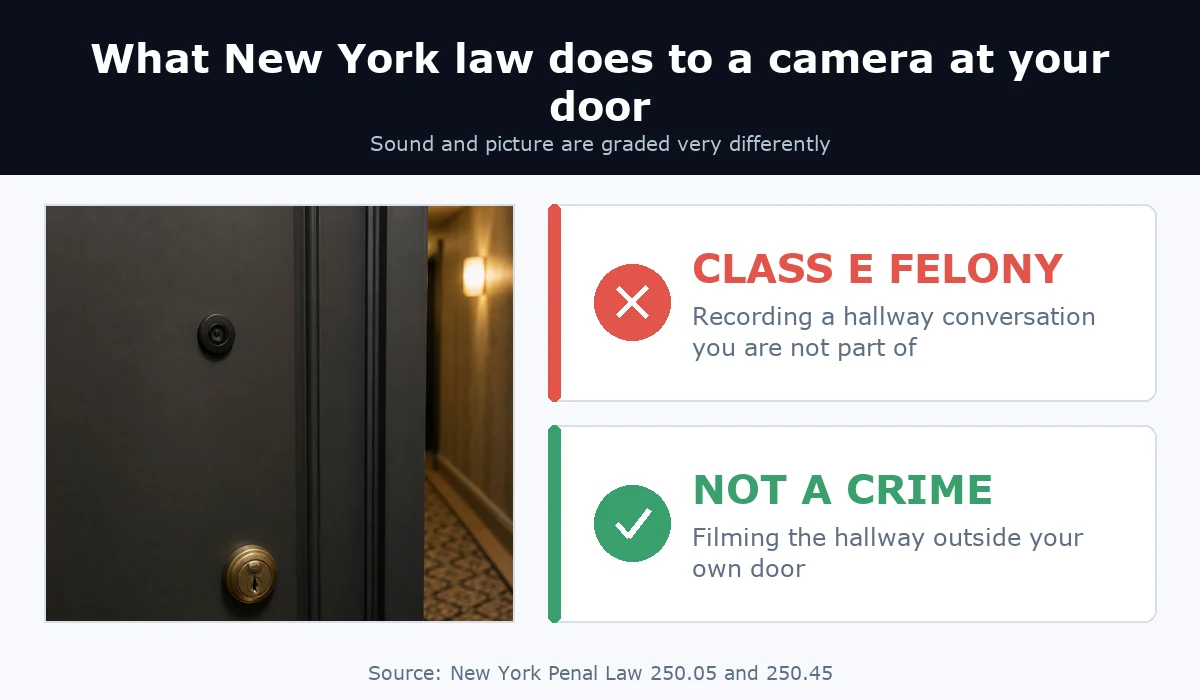
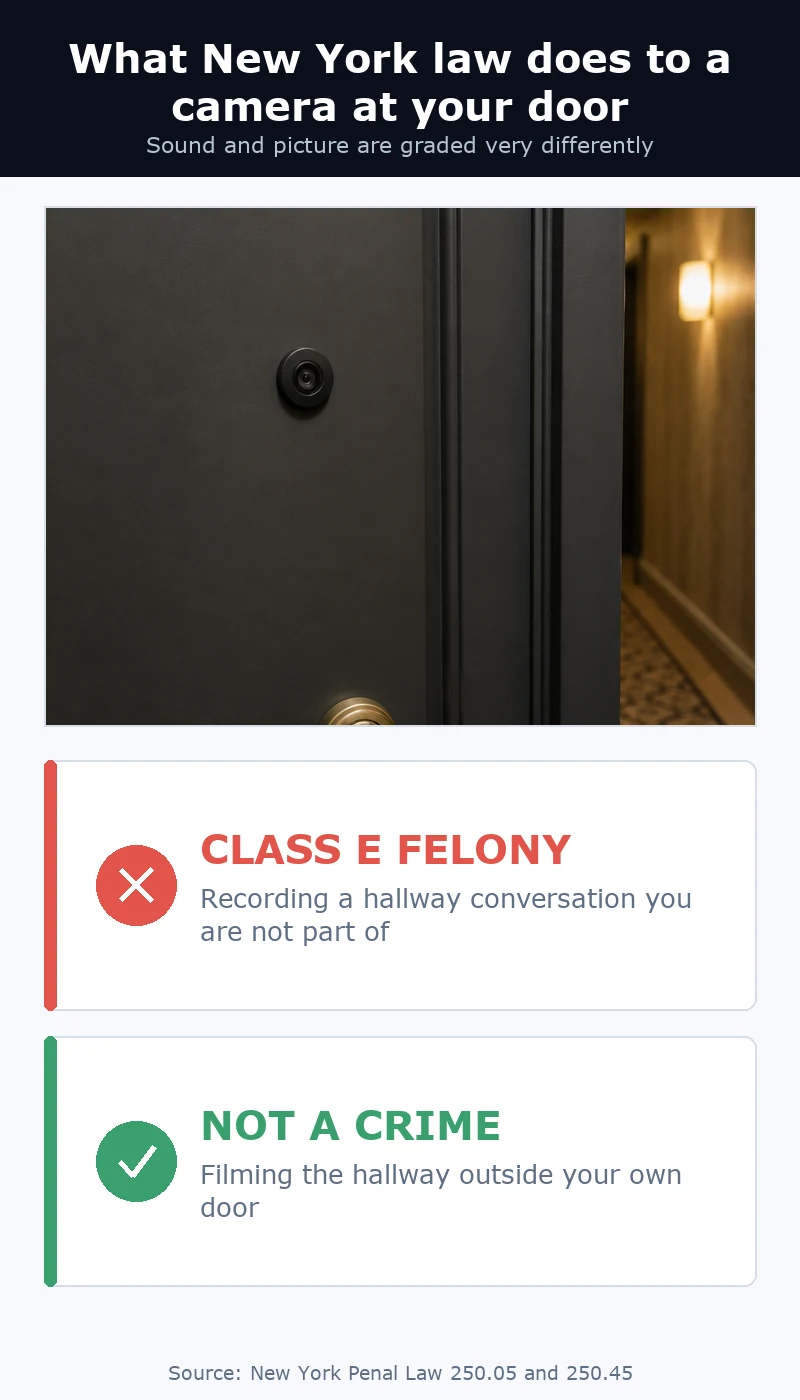
- Turn the microphone off. New York treats recording a conversation you are not part of as eavesdropping, and that is a felony.
- Your landlord has to provide and maintain the peephole, so putting the original one back is on you when you leave.
- Apartment entrance doors are often fire rated. A labeled viewer is allowed; a hole somebody drills on site is capped at one inch.
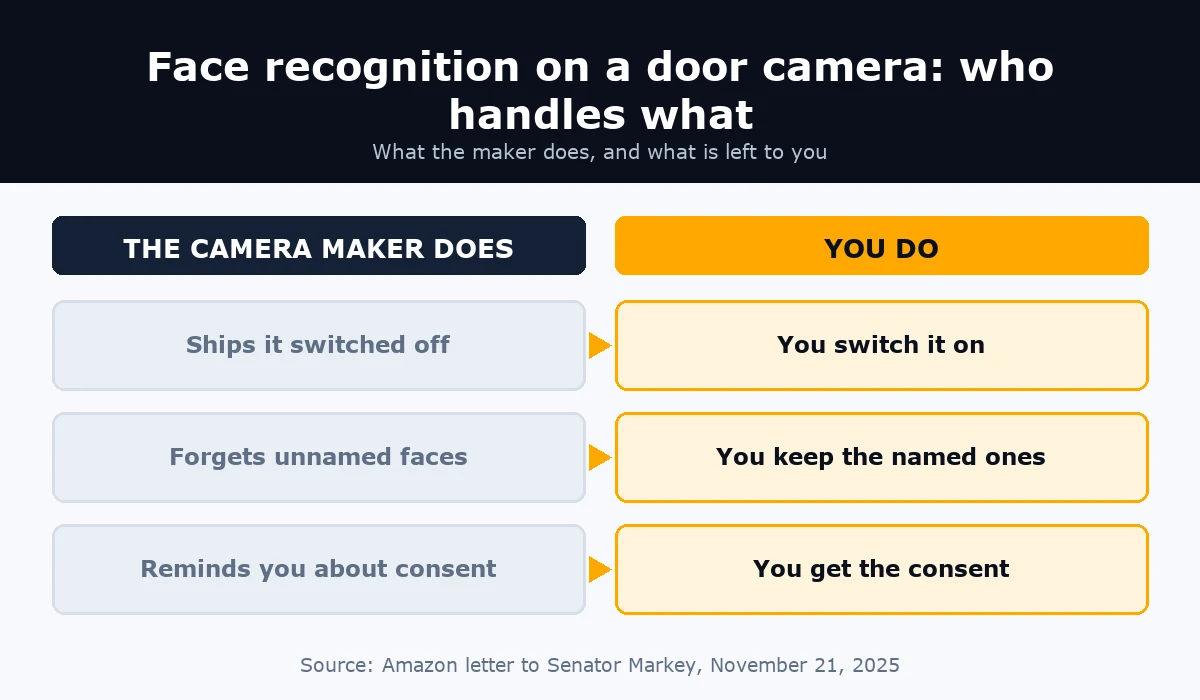
- Amazon told a United States senator that it reminds you to follow biometric law. Getting anyone's consent is your job, not the camera company's.
This is general information, not legal advice. It comes from the city and state codes linked below and from the doors my team works on. Your lease and your building's house rules can change the answer, so read your lease and ask your managing agent before you put anything on a door you rent.
Can I put a camera outside my apartment door?
Usually yes. People get stuck because this is really two questions wearing one coat.
The first is about property. The door is your landlord's, and so is the frame around it. Anything you attach to their property is a change to their property, which is why your lease decides this and not the law. If yours says nothing about cameras, that silence is not permission.
The second question is about privacy, and it does not care who owns the door. Your own doorway is yours to watch. A shared hallway is a place other people live and walk through, so a lens parked on somebody else's door turns a neighbor into a complaint. Point the camera at your mat, tilt it down, and most of this never comes up.
The lens is the easy half. The microphone carries the real risk, so that comes next.
What your camera is allowed to hear
Turn the audio off. That is the whole recommendation, and here is the reason it is worth the ten seconds.
New York spells the pieces out in Section 250.00 of the Penal Law. One of them is mechanical overhearing of a conversation. It means recording a conversation without the consent of at least one party, by a person not present at it. Now hold that up against a camera in a hallway while you sit inside. Two neighbors stop outside your door and talk, your camera records them, and you were never there. That is the exact shape the definition describes, and doing it is eavesdropping under Section 250.05, a class E felony.
Video is the opposite story, and most of the worry people bring me points at the wrong half. Section 250.45, unlawful surveillance in the second degree, covers filming someone dressing or undressing somewhere they expect privacy, and it names bedrooms, bathrooms, changing rooms and fitting rooms. A public hallway is none of those. So the lens on your doormat is not the thing to lose sleep over. The microphone left switched on is.
The peephole is not yours to remove
Nobody selling you a camera mentions this, and in New York City it is written down. Section 27-2041 of the Housing Maintenance Code says the owner shall provide and maintain a peephole in the entrance door of each unit, placed so you can see anyone standing right outside.
Provide and maintain. Both words matter here. Most peephole cameras work by taking out the viewer already in the door and running the camera through that same hole. Do that, and a piece of equipment the owner has to keep working is now in your junk drawer. Nobody will arrest you over it. What happens instead is that you move out, the camera goes with you, and the door is left with a bare hole. Bag the original viewer the day it comes out, and screw it back in before you hand over the keys.
So do you have a right to a camera at all? No, and it helps to see what a real right looks like. Under Section 51-c of the New York Multiple Dwelling Law you may add one lock of your own, no more than three inches around, and hand the landlord a duplicate key if they ask. State law wrote that down for locks. It wrote nothing like it for cameras, which is why your lease does all the work here. We cover how that lock right plays out on a real door in our post on which lock an apartment door actually needs, and what the city says about keyless buildings in can you copy an apartment key fob.
Your apartment door is probably a fire door
Before you let anyone drill it, look at the edge of your door on the hinge side. A small metal or foil label there, with a maker and a rating on it, means the door was tested and certified as a whole assembly. Cutting a new hole in it stops being a hardware decision at that point.
Fire doors are governed by NFPA 80, which is specific about what may be done to one in the field rather than in a factory. As the trade journal Locksmith Ledger sets out in its walkthrough of Section 5.1.5.2, holes for labeled viewers are on the allowed list. Round holes drilled on site have long been capped at one inch across, with cylinders as the exception. Editions from 2016 onward allow bigger holes for surface mounted hardware, but only where the door maker's own listing says so. Get an unapproved hole wrong and the door may have to be relabeled by the testing lab, which means a site visit and a bill.
So a camera using the peephole hole you already have is the low risk option, and that is why so many are built that way. A camera needing a fresh opening is a question for your building first, and a door hardware tech second. While you are down there, check that the door still closes and latches on its own. That self closing action is required under the same housing code, and a door failing it is a class C immediately hazardous violation.
Your camera can now put a name to your neighbor's face
This is the piece that changed recently, and it made the hallway question sharper. Ring added a facial recognition feature called Familiar Faces. It learns the people who turn up at your door and puts their name in the alert, instead of saying a person was detected.
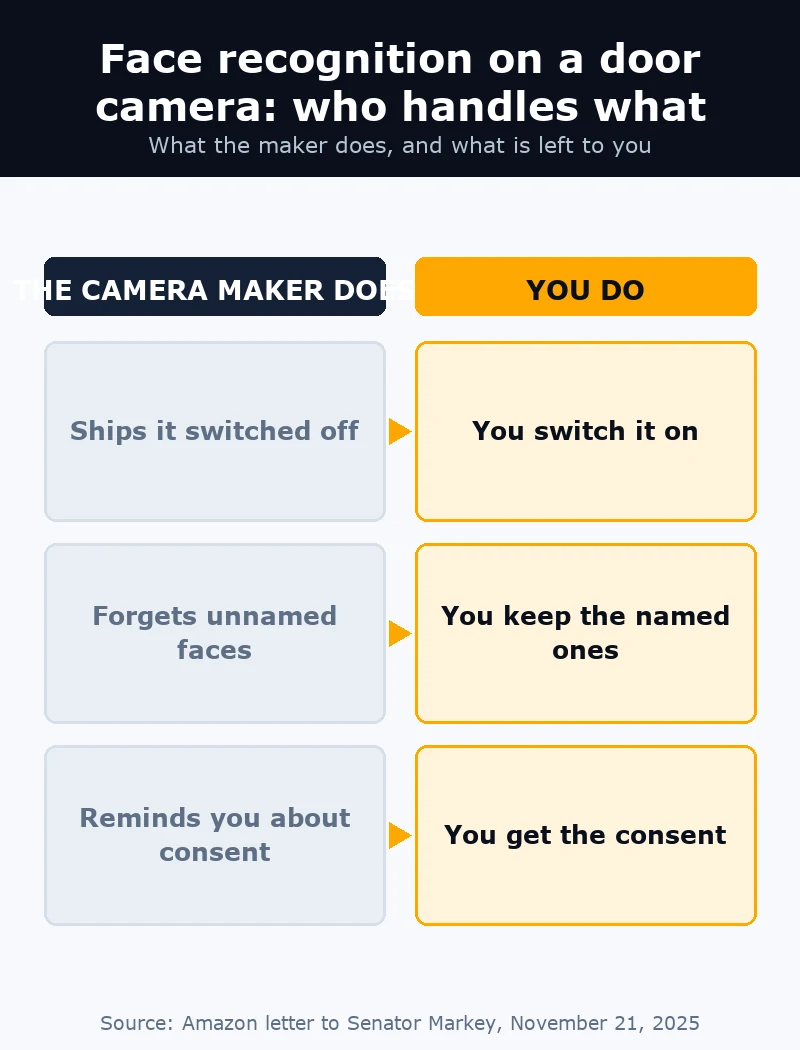
The details are public because a senator asked for them. On November 21, 2025, Amazon's vice president of public policy wrote back to Senator Edward Markey, and that reply sits on the Senator's own site. The feature is disabled by default, so a customer has to switch it on. Data for an unnamed face is deleted after thirty days, while a face you have named stays until you delete it.
Then comes the answer a renter should read twice. Markey asked how Ring would get informed consent from every person whose face is captured, including passersby, delivery workers and guests. Amazon said customers agree to use its products in line with applicable laws, and that turning the feature on shows a message reminding you to comply with laws that may require consent. That is the whole mechanism. The company shows you a reminder, and the duty lands on you. A neighbor who wants their footage handled is told to contact the device owner. In a hallway, that owner is you.
Ring's own support page lists where the feature is not offered, all for legal reasons: Illinois, Texas and Portland, Oregon, plus Quebec in Canada. New York is not on that list, so it works here. If your camera faces a shared corridor, leave it off. Naming every neighbor who walks past your door is a lot to explain at a building meeting.
5 things I settle before a camera goes on an apartment door
None of these are about the camera brand, and none of them are in the box. They are the things that decide whether this is a twenty minute job or a half day of back and forth.
- How thick is the door? Every peephole camera lists a door thickness range, and older buildings ignore it. A door that got a fire rated core added at some point is thicker than the one the camera was designed around. I measure before I order anything, because the part that does not fit is always the barrel.
- Which words are in the lease? Cameras usually get caught by a clause that never says camera. Look for alterations and fixtures, since those are what a managing agent will point at. A yes from the super does not survive a change of management, so get it by email.
- Where does the motion zone reach? Most neighbor complaints I hear about are not really about the lens, they are about alerts. A default zone often covers the whole corridor, so your phone buzzes every time somebody else comes home. Shrink the zone to your own mat on day one.
- Is there a label on the edge of the door? That one label decides whether this is a drill job or a conversation with the building. I check it on every apartment door before I pick up a tool, and I say no to plenty of them.
- How does it get power? There is no outlet in a hallway and you are not running wire through a rented door, so it runs on batteries. Cold stairwells and drafty entrances drain them faster than the box suggests. Buy the spare battery with the camera.
Frequently Asked Questions
My building already has cameras in the hallway. Does that let me add my own?
No, and the two are barely connected. The building owns the common areas, so the owner gets to put cameras there. Your door is still the owner's door. Building cameras help you in one way only: an owner who already films the hallway has a harder time calling one camera at one door a privacy problem.
Can my landlord make me take it down after it is already up?
If your lease bars it, yes, and that is the usual outcome. If your lease says nothing, it comes down to what the camera does. One looking at your own doormat is far easier to defend than one aimed across the hall. Written permission before you mount anything keeps this from becoming a fight, and it costs you one email.
What about a camera inside my apartment pointed at the door?
That is your space and your call, and nothing gets drilled. A small camera on a shelf inside tells you when the door opens and who came in. It will not show you who is standing in the hallway, which is the whole reason most people want one. Plenty of renters end up with both.
Does a stick-on camera avoid all of this?
It avoids the drilling and the peephole, which are the two parts involving the door itself. It changes nothing about where the camera looks, so your lease and the hallway still apply. Test the adhesive on a painted metal door too, because a camera that falls off in August heat is a camera nobody was watching.
My roommate does not want to be on camera. Does that matter?
Inside the apartment it matters a lot, and you two should settle it before anything goes up. At the front door it matters less, because your roommate uses the same doorway you do. Worth knowing: if only one of you signed the lease, only that person can ask the landlord for permission, so the signer has to make the request either way.
Talk to Us Before Anyone Drills Your Apartment Door
We work on apartment doors in Manhattan, Brooklyn, Queens, the Bronx and Staten Island. One look tells us whether your door is rated, whether the peephole you have will take a camera, and what to put back before you move out. Call (646) 781-7070 or send us a photo of your door edge.