

The handle on a New York shop door went in at whatever height suited the person who drilled it. Nobody measured it then, and nobody has measured it since. If you ignore that, a lawyer's letter usually arrives before any inspector does.
The Americans with Disabilities Act, known as the ADA, covers the front door of almost every shop, office and clinic in this city. A customer who cannot open your door can sue the business over it.
Three people ask us how high a door handle has to be. A shop owner asks after a lawyer's letter arrives. A managing agent asks because an architect flagged the hardware on a filing. A contractor asks before drilling a new door.
A search for that height gives you one number back. The pages that answer it never say what counts as a handle. Height is one of four checks on the same door. An old New York door usually passes the height and fails one of the other three, and we fix most of those with a hardware swap rather than a new door.
Here is how to check your own door, in the order it happens: step one measures every part you touch. Step two checks the shape of that part. Step three weighs the door and times the door closer, which is the arm at the top that pulls the door shut. By the end you will know what the ADA door handle height is, how to measure every part you touch, which shape passes, and what the law asks of an old storefront.
I am Roye Gvili, and I run Top Notch Locksmith & Security out of Manhattan. We change this hardware most weeks of the year.
Key takeaways
- Handle height is one of four checks. Shape, opening force and closing speed fail doors as often as height does.
- A round doorknob fails on shape at any height, because the rules ask for a part you can work with a closed fist.
- Fire doors are let off the five pound opening limit. They still have to take five seconds to close.
- The Justice Department names accessible door hardware as a barrier an existing business is expected to remove.
What is the ADA door handle height?
ADA door handle height has one legal range. A tape measure settles most doors in a minute.
A door handle has to sit 34 to 48 inches above the finished floor, measured to the part you actually touch.
- 34 inches is the lowest the rules allow and 48 inches the highest. A handle anywhere between the two passes.
- Handles, pulls, latches, locks and deadbolt knobs all count. A deadbolt knob is the small knob you turn by hand on the inside of the door.
- A gate around a pool or hot tub is the one everyday exception. Its latch release may sit as high as 54 inches.
Where that comes from: the federal standard for doors and gates sets the range. The standard the city Building Code adopts asks for the same two numbers.
The chart below runs four parts people have on their doors, the height each one usually sits at, and the verdict on every one.

Finished floor means the surface a person stands on. Tile, carpet and a new floor over an old one all count. Measure to the middle of the part your hand touches, not to the plate behind it. The number is only half of it, because a handle in the right place can still fail on its shape.
Step one: measure every part you touch
Measuring every part you touch takes one tape and two minutes. Run a tape from the floor to the handle. Run it again to the deadbolt knob above it, then to anything else on that door: a push bar, a pull on a glass door, a keypad, a card reader. Every one of those heights has to sit between 34 and 48 inches.
What happens when a door carries two of these parts: the lower one can measure perfectly and the door still fails. A deadbolt fitted years after the lock usually sits high, around chest height. Whoever cut that hole picked the easy spot rather than the legal one.
Step two: check the shape, not just the height
Shape decides as much as height does. The rules bar any part that asks for tight grasping, pinching or twisting of the wrist. An ADA compliant door handle is one a person can work with a closed fist. A knob at a perfect 36 inches is not the same as a handle that passes.
| What is on the door | Does it pass | Why |
|---|---|---|
| Round doorknob | No | Opening it means gripping the knob and turning your wrist |
| Lever handle | Yes | A closed fist, an elbow or a forearm pushes it down |
| Push bar across an exit door | Yes | Leaning on it opens the door, with no grip at all |
| Recessed pull on a sliding door | No | Sliding it means pinching a finger into the hollow |
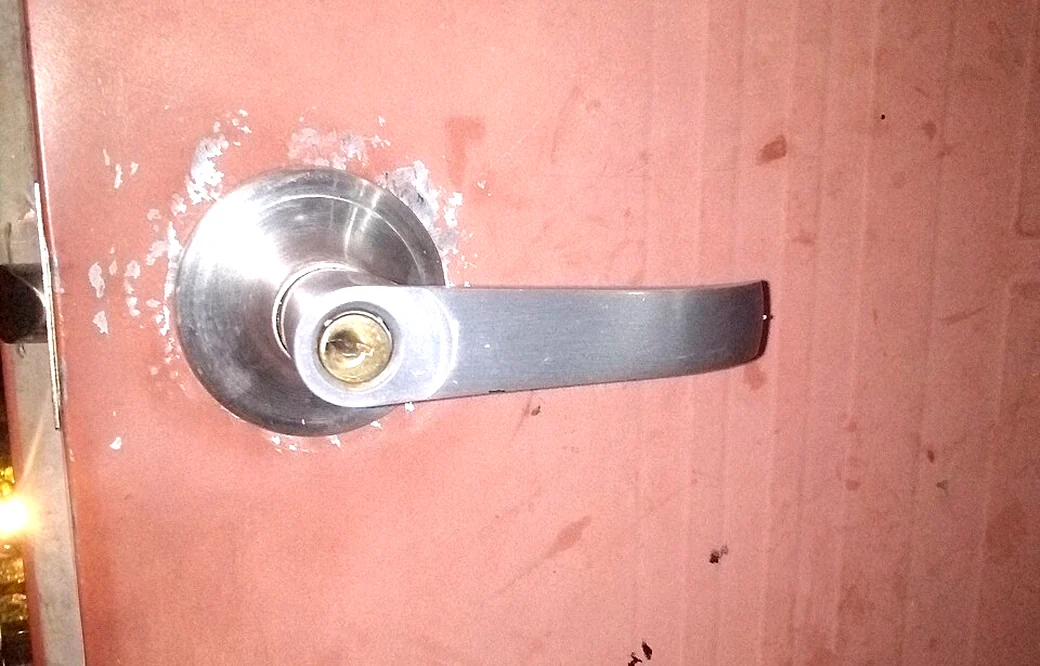
The photo below shows a keyed lever on a steel door. Most New York buildings settle on that shape.
Step three: weigh the door and time the closer
The last two numbers describe the door itself, not the handle. So what do you do first: hook a luggage scale over the handle and pull. An interior door has to open on five pounds of push or pull or less. Read the scale while the door is moving, because the rule measures the push that keeps it going, not the first tug.
Fire doors are the exception on force. A door with a fire label holds smoke back in a stair, so it may need more than five pounds. No door gets a break on speed. Every closer has to take at least five seconds to swing from wide open to nearly shut, and a spring hinge a second and a half.
Most doors fail this check by slamming. Two screws on the closer set the speed, and turning them costs nothing. We went through those screws in the door closer guide.
What ADA door clearance means, and why new hardware cannot buy it
ADA door clearance means the width of the opening, and nothing about the handle. A doorway has to leave 32 inches of clear space. You measure it with the door open at a right angle, from the face of the door across to the stop. Hinges and closer arms eat into that.
A new handle does nothing for a narrow doorway. A swing clear hinge buys a little room back, because it folds the door clear of the opening. The Justice Department lists that swap as one way an existing building widens a door. Anything more is carpentry.
Which New York doors these rules cover
These rules cover any space open to the public: a store, a restaurant, a clinic, an office that takes visitors, a gym. If you leave an old entrance alone, age buys it no exemption. The owner still has to remove the barriers it readily can, which the law defines as easy to do without much difficulty or expense. The Justice Department's own list of examples includes installing accessible door hardware, and the same rule puts the entrance first.
New work is judged harder. When you file a job with the Department of Buildings, the plan examiner reads it against the accessibility chapter of the city code. That chapter carries the same range for every door the job touches.
What we change on a door that fails
Now you know which check your door misses. Here is what a failing door usually needs from us: a knob comes off and a lever goes on in the same two holes, so the door keeps its finish and its fire label.
A deadbolt knob fitted too high comes down into the range. That leaves one new hole and a plate over the old one. A closer that slams gets its valves turned.
Some doors cannot win on force at all. We see it most on heavy exterior doors in windy blocks. Our answer there is a powered opener with a push pad, and the pad goes at the same height as everything else. We fit the same hardware in homes, where no law applies and the reasons are the same.
Is 36 inches the required door handle height?
No, and the rules never name 36 inches. Most installers put a lever there out of habit, and that height sits in the middle of the legal range. A handle at 40 inches is just as legal as one at 36.
How high should the push bar on an exit door sit?
Inside the same range. The bar you push to get out is a part you touch, so the section that covers handles covers it too. Most exit bars mount around 38 to 42 inches, so they rarely fail this check. We fit and service exit bars across the city.
Does a keypad or a card reader have to sit at that height too?
Yes. A keypad, a card reader and a push plate are all parts a person operates, so each belongs at the same height. We find readers mounted high on the frame, over the limit. The wire went in before anyone held a tape to the wall. Moving one down is a short job.
Do these rules apply to my apartment door?
Not to your own apartment door. This law covers places open to the public, so a lobby, a leasing office and a ground floor shop are in, and your front door is out. Housing runs on its own accessibility law. Your apartment door does owe a separate list of city rules, and we went through those here.
Not Sure Whether Your Door Passes?
Send a photo of the door with a tape held against the handle and we will tell you which checks it misses and what the fix costs. We cover Manhattan and all five boroughs for commercial door and lock work. Call (646) 781-7070 or use our contact page.
Cover photo by Scott Brody, CC BY-SA 4.0, via Wikimedia Commons.