

A door in your building stopped shutting by itself, and a new door closer fixes it. A door closer is the small cylinder and jointed arm at the top of a door that pulls it shut behind you. Maybe yours gave up and left an oily streak down the paint. Maybe the door never had one, and the hallway goes cold every time somebody leaves it open.
Door closer installation starts with the door you have, not with the closer you buy. Before anybody drills a hole, one measurement across the top of the door rules out some of the three mounts, and a closer being replaced often wants a different mount than the one that gave up.
So let us walk through it in the order it happens to you. By the end you will know which of the door closer types your door takes, which part is worn when one stops working, what the job involves step by step, the two numbers it has to hit, and why doors stop latching once the weather turns.
I am Roye Gvili. I run Top Notch Locksmith & Security out of Manhattan, and door closers are the part we fit most on apartment, office and storefront doors in all five boroughs, including the stair and entrance doors the city inspects.
Key takeaways
- A steel commercial door has a thick plate welded inside its top corner for the closer to grab, and a door without one needs bolts passed right through it instead.
- After a door closer installation the door has to take at least five seconds to swing from wide open to almost shut, which is the federal accessibility number every inspector checks.
- A door inside the building is allowed to need five pounds of push and no more, while the front door of the building may need thirty pounds to get it moving.
- The fluid inside a closer thickens as the weather gets colder, so a door that latched all summer can stop latching in January without anything being broken.
Which mount does your door take?
There are three surface mounts, and the solid band across the top of your door, called the top rail, decides which ones you can use.
- The body on the face of the door, on the side you pull, with the arm reaching up to the frame. That is the regular arm mount, and it is the one on most apartment and office doors.
- The body on the frame above the door, with the arm coming down to the door face. That is the top jamb mount, and it suits a door you push to go out.
- The body on the side you push, with the arm folded back flat along the frame. That is the parallel arm mount, and it keeps the arm out of the way of people and carts.
Where that comes from: LCN, which is one of the oldest American closer makers, prints a minimum for each mount in its own sheet.
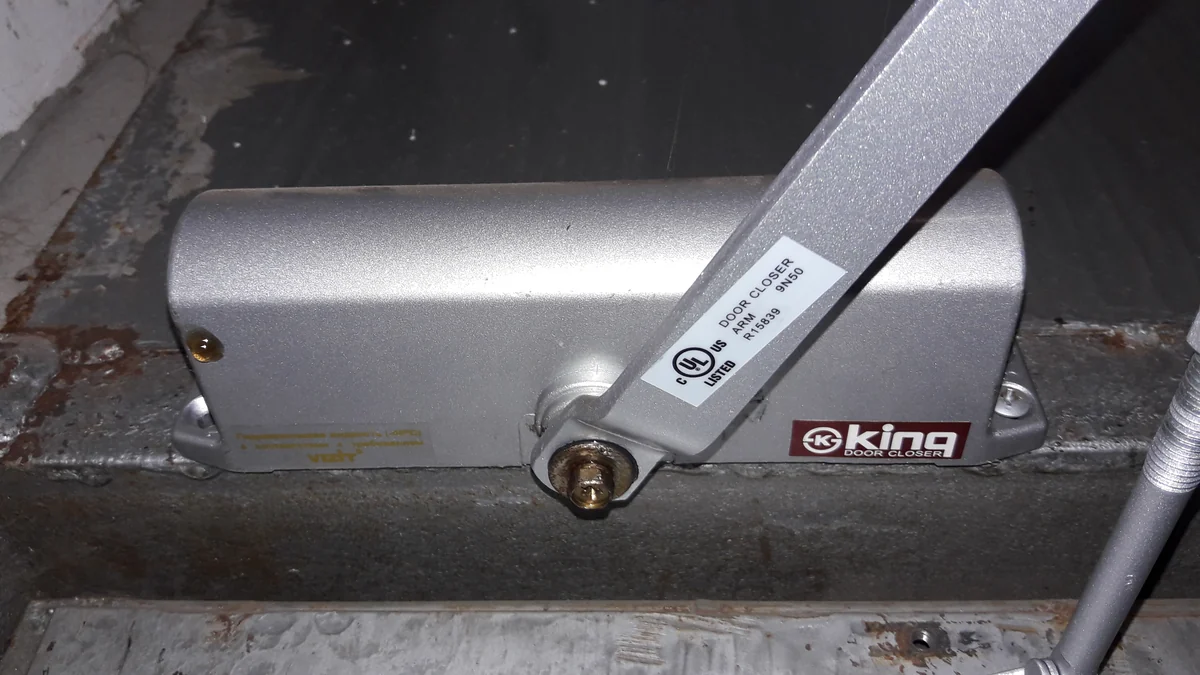
So measure that band before you shop, from the top edge of the door down to where the glass or the panel starts. The regular arm mount wants about 3-3/4 inches of it and the parallel arm about 5-1/2 inches. A door with less does not stop the job: the closer goes on a flat steel plate that gives the screws something to bite into.
One more thing decides the mount. A closer hanging off the frame sticks down into the doorway, and New York's building code says in section 1003.3.1 that door closers and stops shall not reduce headroom to less than 78 inches. In an old building with a low frame above the door, that rules the top jamb mount out.
What is inside the closer, and which part wears out
Here is what happens inside that aluminum body. Pull the door open and a steel spring inside it is squeezed, and it stays squeezed while the door is open. Let go, and the spring pushes back.
The door would slam if that were all. So the body is also full of oil, and the spring drives that oil through small passages as it pushes. Three screws on the end of the body open and narrow those passages, and each owns a different part of the swing: the shove as you open it, the long swing back, and the last few inches where the latch has to catch.
One of those screws needs a warning. It cushions the door as it opens so the door does not fly into the wall, and it is not a door stop. LCN puts that plainly: the cushion does not replace the stop, and a separate stop should be provided.
So what a door does tells you which part is at fault, and whether you are buying a screwdriver turn or a new closer.
| What the door does | The part behind it | What it usually takes |
|---|---|---|
| Swings shut fast and bangs the frame | The screw for the last few inches | A quarter turn, no parts |
| Drifts shut and stops short of the latch | Spring set too low for the door, or oil gone stiff in the cold | The spring size turned up, or a closer with all weather oil |
| Leaves oil on the door under the body | The seal inside the body | A new closer, because the body is sealed and cannot be refilled |
| Takes two hands to open | Spring set too high, or hinges binding | The spring size turned down, then the hinges checked |
| Bent arm, or screws pulling out of the door | Nothing stopping the door at the end of its swing | A door stop fitted first, then the arm or the closer |
Door closer installation, step by step
Here is the order the work happens in.
- Find out what the door is made of. A commercial steel door carries a thick plate welded inside its top corner for the closer to grab. No plate means the screws tear through the skin, so the fix is bolts passed right through the door. A wood door needs a solid block of wood behind the same spot.
- Match the closer to the door. Spring power is sold in sizes, and LCN's sheet runs 1 through 6 on one adjustable body, low numbers for a narrow inside door and high for a wide or outdoor one. Guess low and the door never latches.
- Tape up the paper template from the box. Every model drills in different places, so the template that came with yours is the only one that fits. LCN says a closer has to be installed with the manufacturer's fasteners and templates to work properly long term.
- Drill the pilot holes, then mount the body and the arm. Body first, then the bracket on the other surface, then the arm between them. The arm is wound against the spring by a set amount before its two halves are tightened, and that wind-up is what pushes the door shut at the end.
- Set the speeds, then time it. Turn each screw a quarter turn at a time, never all the way out.
The two numbers a finished job has to hit
A closer can be screwed on perfectly and still be wrong, because two numbers decide whether people can use the door. The first is time. The federal accessibility standards, in section 404.2.8.1, say a closer has to be set so the door takes at least five seconds to travel from wide open at 90 degrees to 12 degrees from the frame. Count it with a phone. Most doors people complain about are at two or three.
The second number is how hard the door is to pull open. Somebody pulls on the handle side, not the hinge side, with a small spring gauge, and the code sets the limit by which door it is. New York's building code says in section 1010.1.3 that an interior swinging egress door, which is any inside door on the way out of the building, shall not need more than 5 pounds unless it is a fire door, while other swinging doors may need up to 30 pounds to set in motion and 15 pounds to swing fully open. The same section adds the part that settles most arguments: those limits are for moving the door, and they do not cover the force it takes to pull the latch back.
That gap is why a heavy front door feels nothing like a hallway door and is still legal. Doors held shut by a magnet, or by an electric strike, which is a powered catch set into the frame, have rules of their own, which we went through separately.
Why doors stop latching once the weather turns
The oil inside the closer gets thicker as it gets colder, and thick oil moves through those passages slowly, so a closer that worked all summer pushes too gently to catch the latch. LCN describes it plainly: without all weather fluid, a closer may creep closed slowly when it is cold, or slam shut when it is hot. Its own fluid is rated to keep working from 120 degrees down to 30 below.
New York's heat season started on October 1 and runs through May 31, with owners required to keep apartments at set indoor temperatures, so a lobby door that no longer pulls itself shut now costs the building money too. Do not crank the screws wide open to force a cold door shut. That buys a door that slams every day next summer, and the honest answer on an older unit is usually door closer replacement rather than another adjustment.
What you get when we put one on
- We measure the door before anything is ordered, so the closer that arrives is sized to the door you actually have.
- A fire labeled door keeps tested hardware, and we read the label on the hinge edge first.
- We pull the door with a spring gauge before we leave, so it is not harder to open than the New York City Building Code allows.
Frequently Asked Questions
Is a Grade 1 door closer better than the rest?
Less than the label suggests. A door closer is the cylinder and jointed arm at the top of a door, and Grade 1 is the top mark in the industry test for one. The makers say that mark separates almost nothing: LCN, which is one of the big American closer makers, writes that most commercial units already meet the Grade 1 requirements, so the grade alone will not define the level of closer you want. Ask about the spring size for your door instead.
How long should a door closer last?
Decades on a door that is not abused. LCN backs its most common surface closer with a 30 year warranty, which is not a promise you make about a part that wears out quickly. What shortens that is a door with no stop on it, a closer sized too small for the door, and people hanging on the handle.
Can a closer go on a door with a fire label?
Only one tested for it. A fire labeled door keeps a closer carrying the same testing mark, and a model with a hold open feature is allowed only where the alarm system releases it so the door shuts by itself in a fire. The label on the hinge edge of the door is what decides it.
What about a glass storefront door?
An aluminum storefront entrance usually takes a closer set into the floor under the pivot, not a surface body, because the frame is too narrow to screw one to. That is a different part and a different price, and we cover it under door closer service.
Got a Door That Will Not Close Itself?
Send a photo of the top of the door and the frame above it, and we will tell you which mount it takes. We cover Manhattan and all five boroughs around the clock, for door hardware. Call (646) 781-7070 or use our contact page.