

You are putting a card reader or a keypad on a door, and the quote in front of you names one of two devices. One is a maglock. The other is an electric strike. The prices are not close, and neither is the amount of work.
The difference is not really the device. One of them is a single part that goes into the door frame. The other is a part plus a sensor, plus a button at a measured height, plus a wire back to the fire alarm panel, because the city code says a door people exit through has to open for them anyway. That is why a maglock install and a strike install are not the same quote, and the inspection is a bad place to find it out.
By the end you will know what each device does, which one your door takes, what fail safe and fail secure mean for the people getting out, what the city asks for before a magnet goes on a door, and what changes in 2027.
I am Roye Gvili, and I run Top Notch Locksmith & Security out of Manhattan, fitting access control on apartment buildings, offices and storefronts in all five boroughs.
Key takeaways
- Price is not the reason to pick one. The door and its frame decide it, and a fire label decides it after that.
- A maglock has no moving parts, so it forgives a door that no longer lines up. That is the real reason people reach for one.
- Both code sections that allow a magnet on an exit door apply only to buildings in Groups A, B, E, M, R-1 and R-2.
- A strike cut into a thin aluminum storefront frame can need a new frame section, which is where a cheap-looking quote gets expensive.
- The city's new Existing Building Code was enacted on January 17, 2026 and starts on July 17, 2027, so door hardware in an existing building gets a new rulebook.
Which one does your door need?
On most doors the electric strike is the right pick, because the door already has a latch and the strike just lets that latch go. A maglock is the answer when there is no latch to work with, and it brings a sensor, an exit button and a fire alarm connection along with it.
- A door that still latches shut by itself takes a fail secure electric strike behind the lockset you already have.
- A pair of glass doors, or a door that no longer meets its latch, takes the magnet, because a strike has nothing to release.
- A door with a fire label takes neither one as the thing holding it closed.
How I know: the city sets out what each device has to do on a door people leave through, and the sections that do it are quoted further down.
Here is how the four openings I get called about usually end up, and the door decides it rather than the budget.
- A pair of glass doors in a vestibule. No frame to cut and often no latch, so this is the opening a magnet was made for. Budget for the sensor, the exit button and the fire alarm connection on day one, because those are not extras.
- An apartment building lobby door that still latches. A fail secure electric strike behind the existing lockset, every time. The door keeps working in a blackout, and the reader you choose is a separate decision from the hardware.
- An office suite door inside a building. A strike again, and check the frame first. These are usually hollow metal and take one without trouble, which makes office doors the cheapest of the four to do.
- A stair door, or anything with a fire label on the hinge edge. Neither device holds this door closed. Keep the latch, electrify the lockset or fit a fail secure strike listed for fire doors, and leave the closer and its mount alone.
What a maglock is, and what holds the door shut
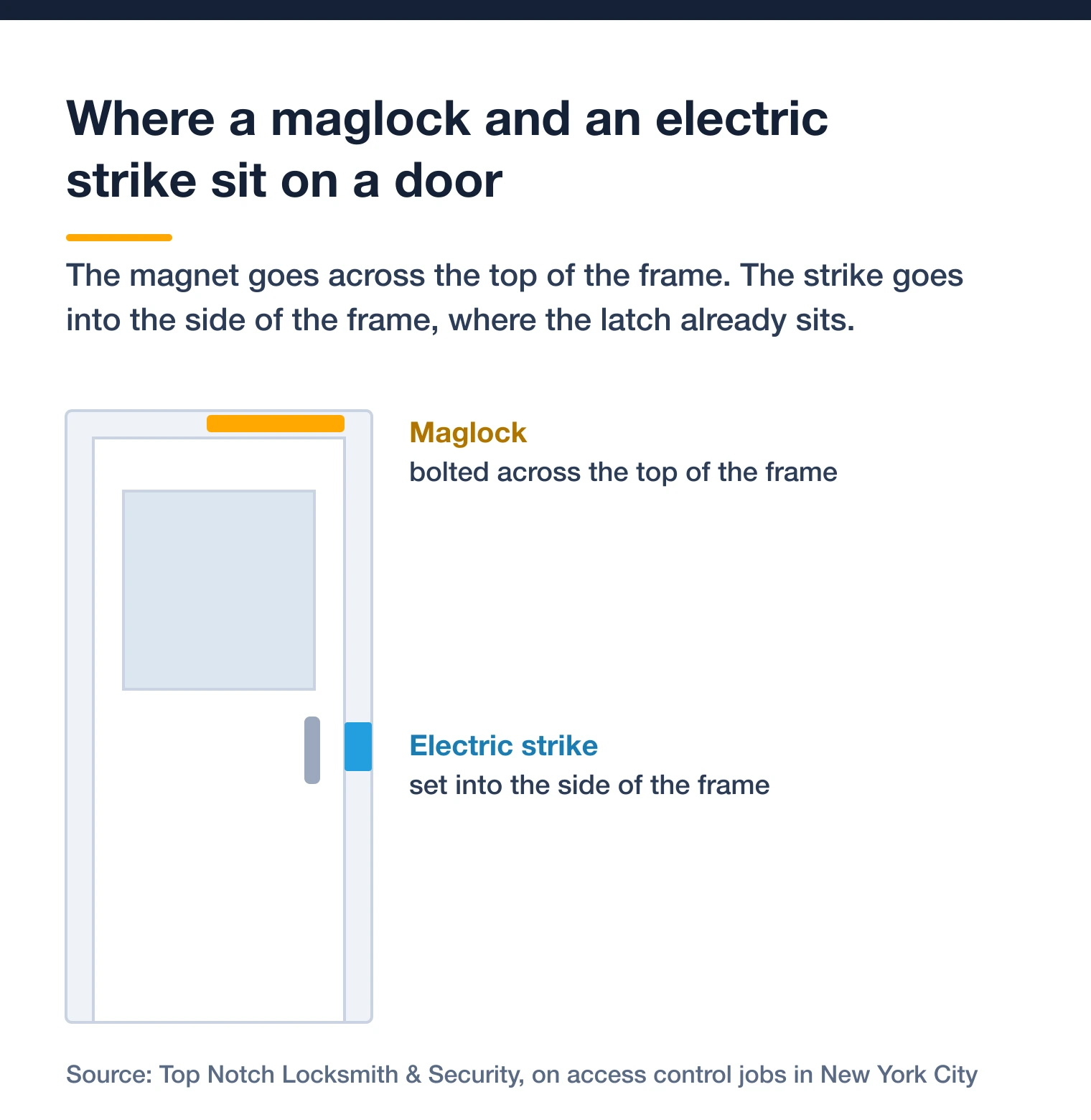
A maglock holds the door with nothing but magnetism. The electromagnet is bolted to the frame at the top of the opening, a flat steel plate is bolted to the door facing it, and current through the magnet pulls the two together.
Nothing inside it moves, and there is no bolt and no pocket in the frame, which is why a magnet goes on doors other hardware cannot serve. A pair of glass doors has no frame to cut, and an old door that has dropped on its hinges will not meet a latch any more. A magnet does not care about either problem.
The cost of that is constant power. The magnet draws current the whole time the door is locked, and the moment it loses power the door is open. On an exit door that behavior is not a weakness, it is the law, and the section below says so in the city's own words.
What an electric strike is, and what it releases
An electric strike does not lock anything. Your door's own latch does the locking, and the strike is the part in the frame that decides whether that latch can come back out.
Look at the edge of any latching door and you will see a metal plate on the frame with a hole behind it. The latch sits in that hole. An electric strike replaces the plate with one whose face pivots on command, so when the reader says yes the face swings clear and the latch slides out. Your key and your thumbturn carry on working exactly as they did, because nothing about using the door by hand has changed.
Fitting one means cutting the frame and running a wire through it, and that is what you are paying for. A deep wood frame or a steel frame usually takes a strike without trouble. A thin hollow aluminum storefront frame sometimes needs a whole new section of frame, so ask whether the quote includes one.
Fail safe and fail secure, and why it is a question about getting out
These two words decide what your door does in a power cut. The hardware maker Allegion defines them in one of its own code articles: "fail safe products are unlocked when power is removed. Power is applied to lock the door." Fail secure is the other way round, so power is what releases the door instead.
A maglock is always the first kind, because taking the power away leaves it holding nothing. An electric strike is sold both ways, and fail secure is what most jobs want, since the door keeps doing its job through a blackout.
The useful question is not which word sounds safer. It is what happens to a person standing inside the door trying to get out. Locks only ever hold people out of a building, so everything the code says about electric locks is written about the inside face of the door.
Maglock vs electric strike, side by side
| What you are asking | Maglock | Electric strike |
|---|---|---|
| What holds the door | A magnet and a steel plate, with no latch at all | The door's own latch, which the strike lets out |
| Power while locked | Constant, all day and all night | Only for the second or two it releases |
| In a power cut | Open, every time | Still locked, if you ordered it fail secure |
| Doors it suits | Glass pairs, gates, and doors that no longer line up | Any door that already latches shut by itself |
| What the install touches | Two brackets, plus a sensor, a button and a fire alarm wire | A cut in the frame and a wire through it |
| On a fire rated door | Not as the thing holding it closed | Yes, fail secure and listed for fire doors |
What New York City code asks for before a maglock goes on an exit door
The code allows it two different ways, and they cost very different amounts. Both sit in Chapter 10 of the 2022 Building Code, and both apply to buildings in Groups A, B, E, M, R-1 and R-2, which covers assembly spaces, offices, schools, stores, hotels and apartment buildings.
The cheaper route is section 1010.1.9.9. Put hardware on the door leaf with a switch built into it, so pushing the bar or turning the lever cuts power to the magnet directly. The code asks for an obvious way to work it in any light, one hand to do it, immediate release, release on loss of power, and release by the panic hardware where panic hardware is required. The unit has to be listed to UL 294.
The other route is section 1010.1.9.8, and it is the one that makes a magnet expensive. There is no hardware on the door, so the building has to prove the door will let people out another way:
- A sensor on the inside face. It sits on the egress side and has to see somebody walking toward the door. The magnet lets go when the sensor says so, and also if the sensor itself loses power.
- A button, 40 to 48 inches off the floor. It goes within five feet of the door and carries a sign reading "PUSH TO EXIT." Pressing it has to cut power to the magnet directly, independent of any other electronics, and the door stays open for at least 30 seconds.
- A connection to the fire alarm. When the alarm sounds the door releases and stays released until somebody resets the alarm. The sprinklers and the fire detection system do the same thing.
- A UL 294 listing on the locking units. The code names that standard, so a no-name magnet off a marketplace is not a compliant part even if it holds the door.
Read that list as a budget, because a magnetic lock installation is four things and not one device. The fire alarm connection on its own brings a fire alarm company into a job that looked like a lock job. One more section nearby, 1010.1.9.5, says getting the door open can never take more than one action, so two things to press is a failed install.
Why a fire rated door keeps a real latch
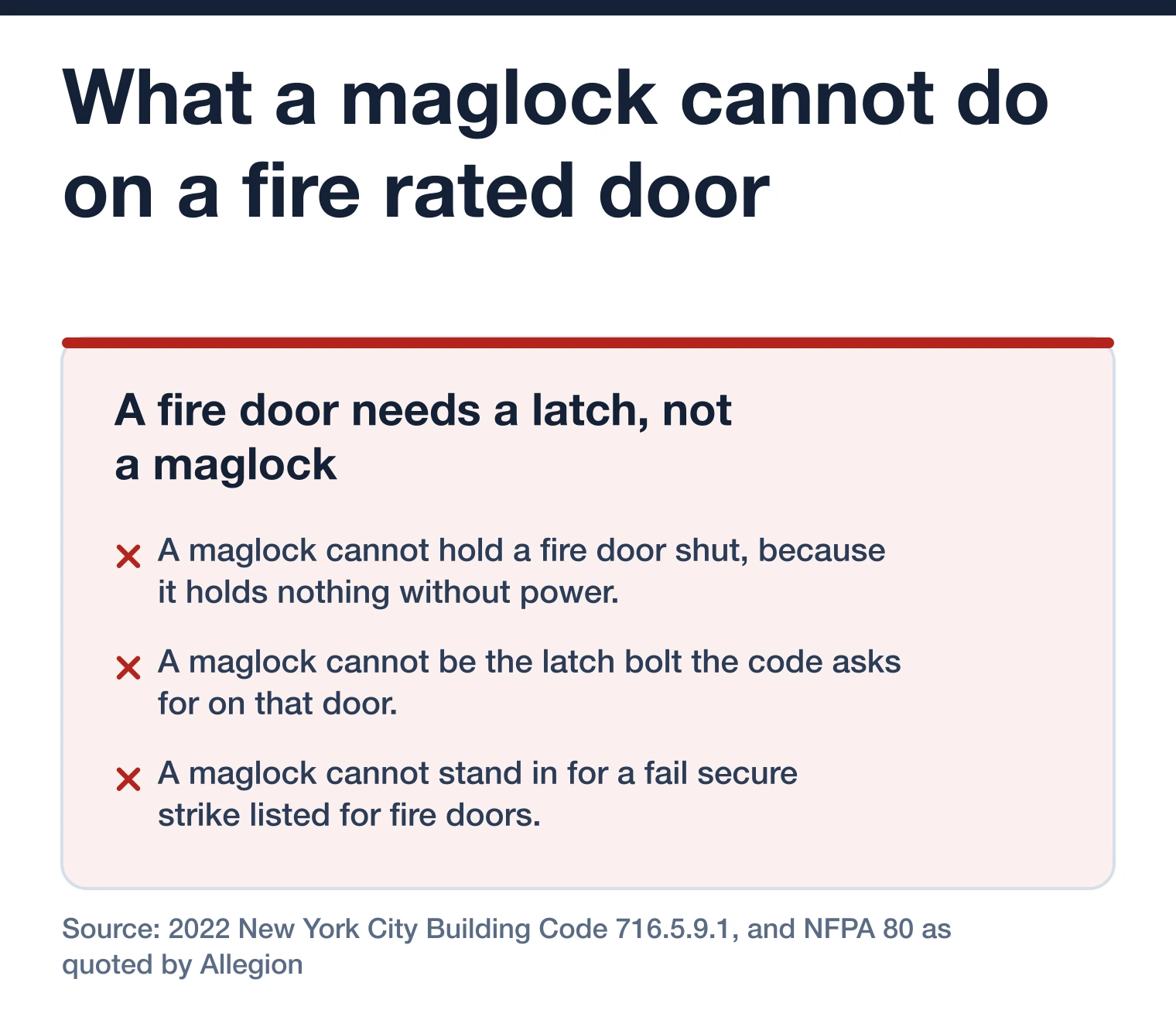
A fire door has to hold itself shut while a fire pushes against it, and a magnet with no power cannot do that. New York City puts it plainly in section 716.5.9.1: a fire door has to be "provided with an active latch bolt that will secure the door when it is closed." The section above it adds that fire doors are latching and self closing or automatic closing.
This is why an electric strike on a fire door has to be the fail secure kind. Allegion says the fail safe version does "not provide the positive latching and the listings required by NFPA 80," which is the fire door standard. The strike also has to be listed for use on a fire door, so the model number matters.
In an apartment building the fire doors are the ones nobody points out: the stair doors, the doors off a corridor, and every apartment entrance door, which has its own hardware rules and its own closer. Put a reader on one of those and the latch stays. The reader works the lockset instead of replacing it.
What changes when the new Existing Building Code starts
New York City enacted a brand new Existing Building Code on January 17, 2026, as the bill numbered Intro 1321-2025. Local Law 42 of 2026 sets the date it starts, July 17, 2027, and it repeals the 1968 Building Code.
That code covers altering and maintaining buildings that already exist, which is every door job in this city. None of the sections above are being thrown out. What is being rewritten is when a change to an existing opening has to meet current requirements, so if your access control work slips into late 2027, ask whoever quotes you which code they are filing under.
Frequently Asked Questions
Do I need panic hardware instead of either one?
On some doors, yes, and that comes before you pick a lock. The Building Code says a door cannot carry a latch or lock other than panic or fire exit hardware where it serves a Group H occupancy, a room holding 75 people or more in an assembly or educational building, or a space used for assembly that is classed as a business occupancy. Such a door can still take a reader. The code says pushing the bar has to release the magnet too.
Can one door have both a maglock and an electric strike?
Yes, and on a heavy pair of glass doors that is often the sensible answer. The strike works with the latch on the active leaf, and the magnet adds holding force at the top where a tall door flexes. You are paying for two devices and two things that can fail, so ask what the second one is for. If the door no longer lines up, fix the door.
Will a battery backup keep a maglock locked through a blackout?
It will, and on a door people leave through that is the wrong thing to want. The code expects that door to let go when the power stops, so a battery holding it shut puts the opening outside what is allowed. Battery backup makes sense on a gate, on a storage room nobody exits through, or on the reader so the system keeps its settings. Ask which part the battery feeds before you pay for it.
Does an electric strike work with a deadbolt?
Not with a deadbolt you throw by hand. A strike releases a spring latch, the sloped one that clicks shut on its own, and a thrown deadbolt sits in the frame with nothing to release it. If the door needs a deadbolt and a reader, the answer is usually an electrified mortise lock or an electric bolt built for the job. Settle that early, because it changes the lockset and not just the frame.
Can I put a maglock on my own apartment door?
That is your building’s call rather than yours, and the answer is almost always no. Your apartment entrance door is usually a fire rated door with a closer on it, so it needs something that holds it shut, and a magnet gives it nothing. What your own door is required to have is a separate question with its own rules, which we covered in the post on what a landlord has to install. If you want a reader on your unit door, ask management first.
Not Sure Which One Your Door Takes?
Send us a photo of the door, the frame and the hinge edge, and we will tell you whether a strike fits it or whether the opening needs a magnet before anybody quotes you. We fit access control on lobbies, offices and storefronts across Manhattan, Brooklyn, Queens, the Bronx and Staten Island. Call (646) 781-7070 or send the photos through our contact page.