

An apartment intercom not working in NYC is the building's problem to fix, not yours. The panel at the front door, the wiring, and the door release belong to the building, so the owner has to keep them working and pay for the repair. Your job is the easy part: work out whether only your apartment is dead or the whole building is, then report it in writing to the super or managing agent. If nothing happens, you can file a 311 complaint, and the Department of Housing Preservation and Development can inspect and write a violation. Most of our intercom and buzzer repair calls start this way.
Safety first. The checks below are the only ones you should do yourself. Do not open a panel, unscrew a station, touch wiring, or work on a ladder. Anything past a battery swap and a look belongs to the super or a licensed professional.
Key takeaways
- Five safe checks tell you whether a dead intercom is the handset inside your own apartment or the building system behind it.
- Section 27-2005 of the New York City Housing Maintenance Code puts the duty to keep the premises in good repair on the owner.
- New York Multiple Dwelling Law section 50-a is the two-way voice intercom rule, and it covers buildings with eight or more apartments.
- Written notice first, then 311. A Housing Preservation and Development violation carries a 30-day or 90-day repair deadline.
This is general information, not legal advice. It comes from the statutes linked below and from the intercom and buzzer calls my technicians run in NYC buildings.
Quick Safe Checks: Is It Your Apartment or the Whole Building?
Five checks, ten minutes, no tools. They tell you and the technician where the fault sits, which is what saves a wasted service visit.
- Check power or batteries at your handset. Older stations are wired only. Newer wireless and video units take batteries or a plug-in adapter. Swap the batteries or confirm the outlet works, and leave the unit closed.
- Ask two neighbors on different floors. One dead apartment usually means your station or the line to it. Three dead apartments means the panel, the power supply, or the wiring.
- Test the door release. Have a friend press your button downstairs while you press the release inside. Voice but no buzz, or a buzz with no voice, splits the problem in half before anyone opens anything.
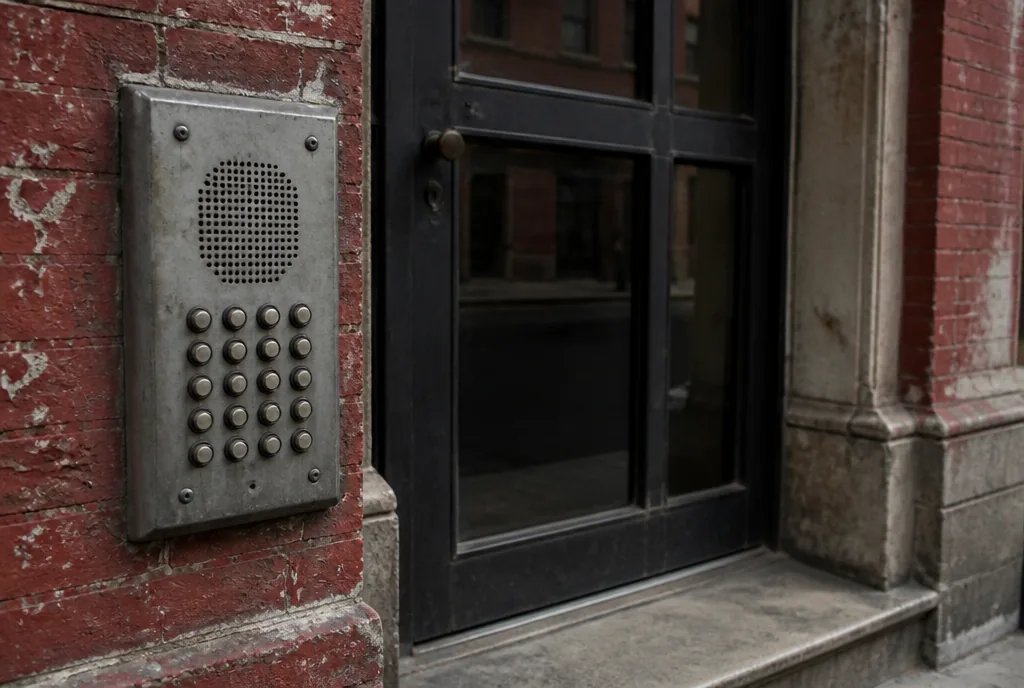
- Look at the street panel, hands off. Water in the button holes, a cover hanging loose, a panel pushed in by a delivery cart, tape over a speaker. I have found all four this year. Note it and step away.
- Report it in writing. Text or email the super with what fails, the date it started, and whether neighbors are affected. Keep the copy.
If that does not fix it, it is a building system issue. Contact your super or landlord, and a licensed locksmith can repair or replace the intercom and buzzer hardware once the building gives the go-ahead.
Who Is Responsible for a Broken Intercom in NYC, and How Do You Report It?
The building owner is responsible. Section 27-2005 of the New York City Housing Maintenance Code states that the owner of a multiple dwelling shall keep the premises in good repair. The New York Attorney General's Residential Tenants' Rights Guide adds that repairs must be made within a reasonable time based on how serious the problem is.
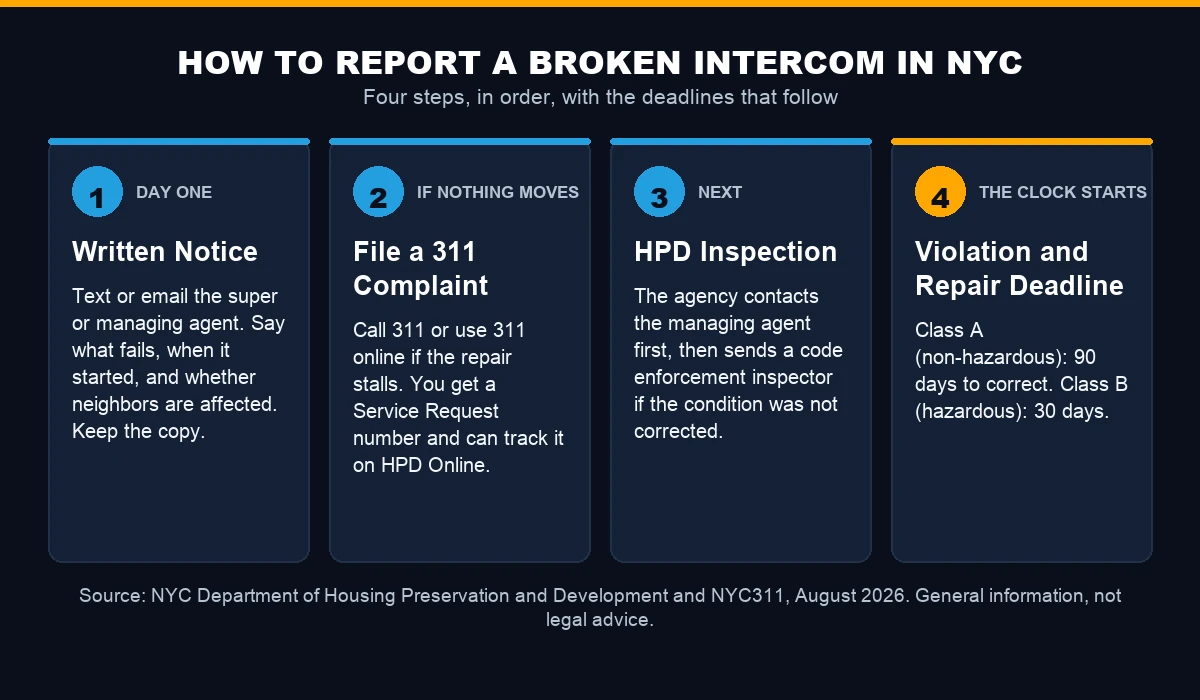
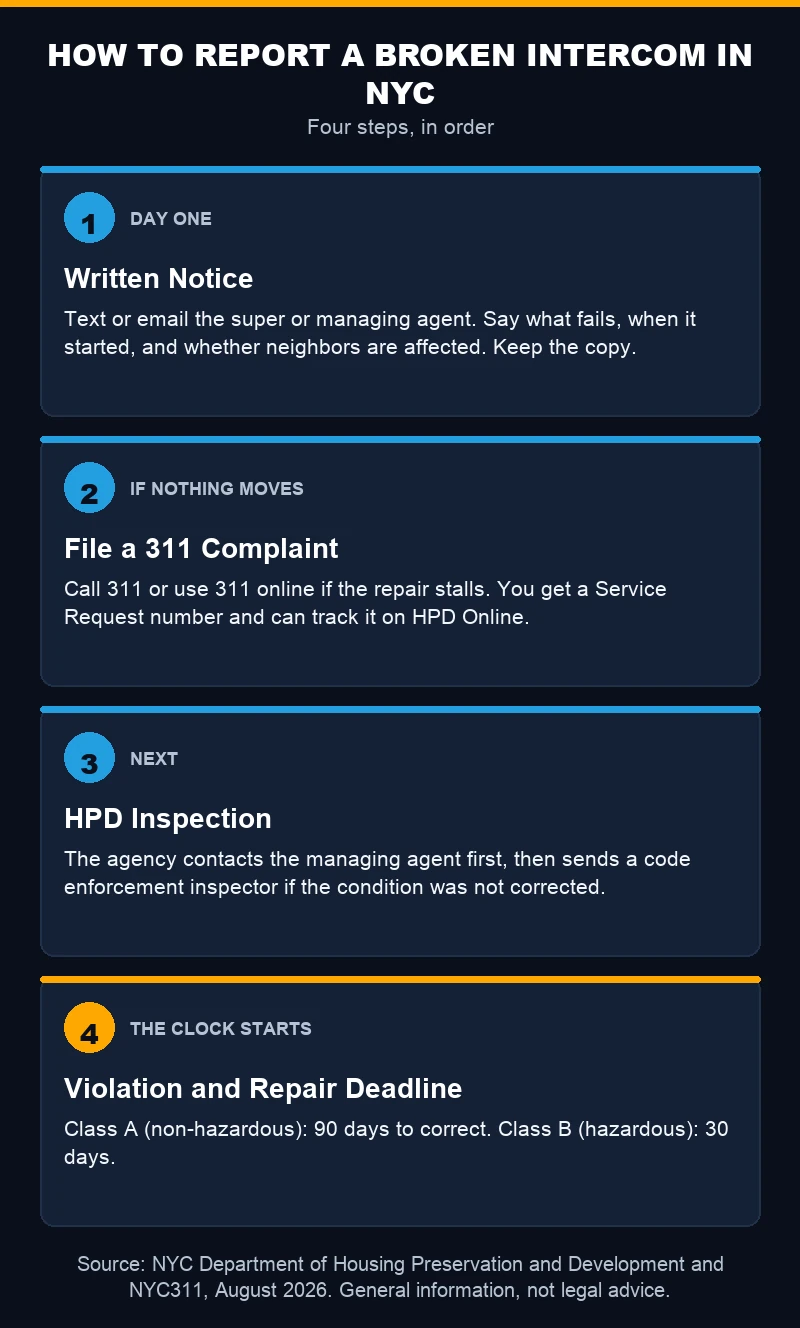
Reporting it goes in this order:
- Tell the super or managing agent first, in writing. NYC311 says to try resolving it with the building first, and in a co-op or condo to start with the management company or board.
- File a 311 complaint if nothing moves. Call 311 or use 311 online. You get a Service Request number and can track it through HPD Online, according to the Department of Housing Preservation and Development.
- An inspection follows. The agency contacts the managing agent first, then sends a code enforcement inspector if the condition was not corrected.
- A violation sets the repair clock. The same agency gives owners 90 days to correct a Class A (non-hazardous) violation and 30 days for Class B (hazardous).
What "Self-Locking Door Plus Intercom" Means, and the Two-Way Voice Rule
The state rule is New York Multiple Dwelling Law section 50-a, titled "Entrances: doors, locks and intercommunication systems." In a class A multiple dwelling erected or converted after January 1, 1968, the entrance doors have to be automatic self-closing and self-locking and stay locked when no attendant is on duty. If that building has eight or more apartments, it also needs a device for voice communication between each apartment and a person outside the front door, plus a way to release that door from inside the apartment. Buildings from before 1968 fall under the same requirement when a majority of tenants ask for it in writing. The same statute sits next to the city rules on what has to be on your apartment door.
So "self-locking door plus intercom" is one system with one job: the front door stays locked, and the way past it is a resident who hears who is there and buzzes them in. That is why a dead buzzer is a security problem, not only an inconvenience. When the voice side fails, people prop the door open, and a propped door is how packages walk away. Knowing the parts of an intercom system helps you describe the failure instead of saying it is broken.
Video is not in the statute, and neither is answering the door on your phone. Those are upgrades a building chooses, usually when an old panel is past repair. Check your lease and house rules too, since a co-op or condo can set terms on top of the city and state rules.
What You Can Do as a Renter and What the Landlord Has to Do
You handle reporting and documentation. The building handles hardware and money.
- Yours: the five safe checks, dated written notice, a 311 complaint if the repair stalls, and copies of everything. A repair case in housing court is also an option worth asking a tenant attorney or a local housing group about.
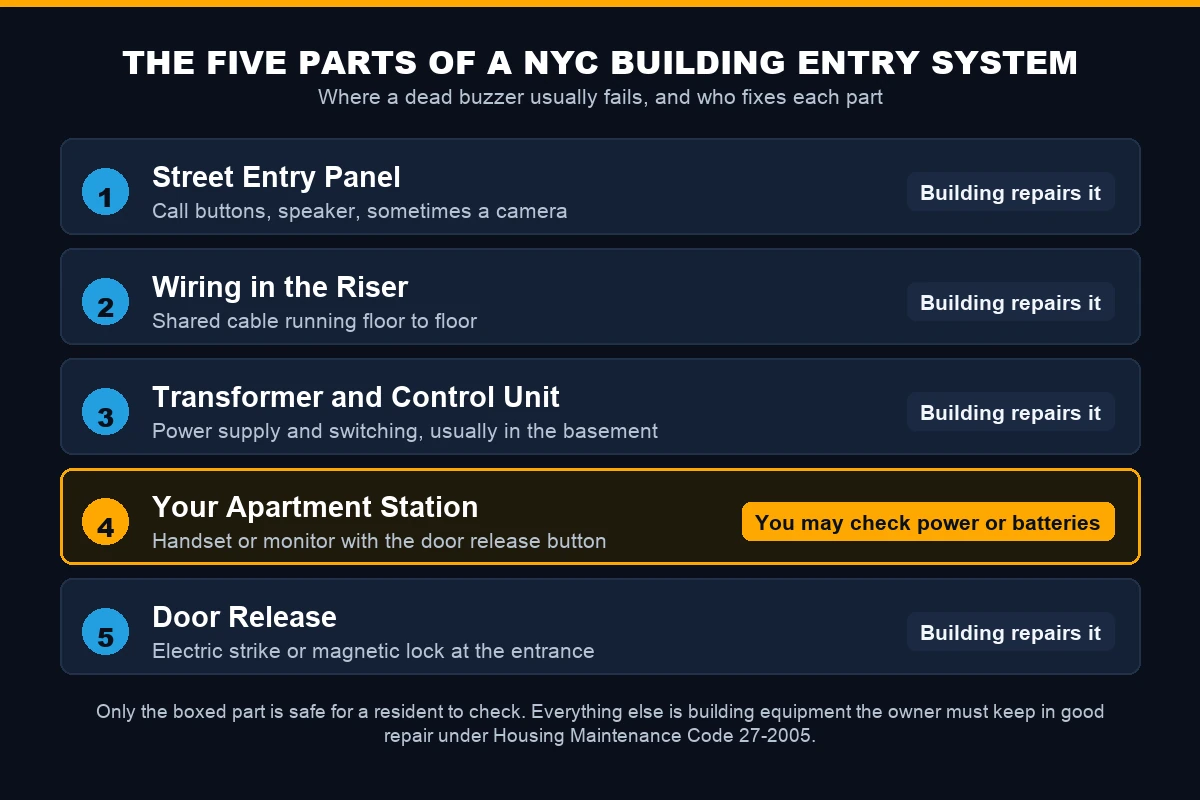
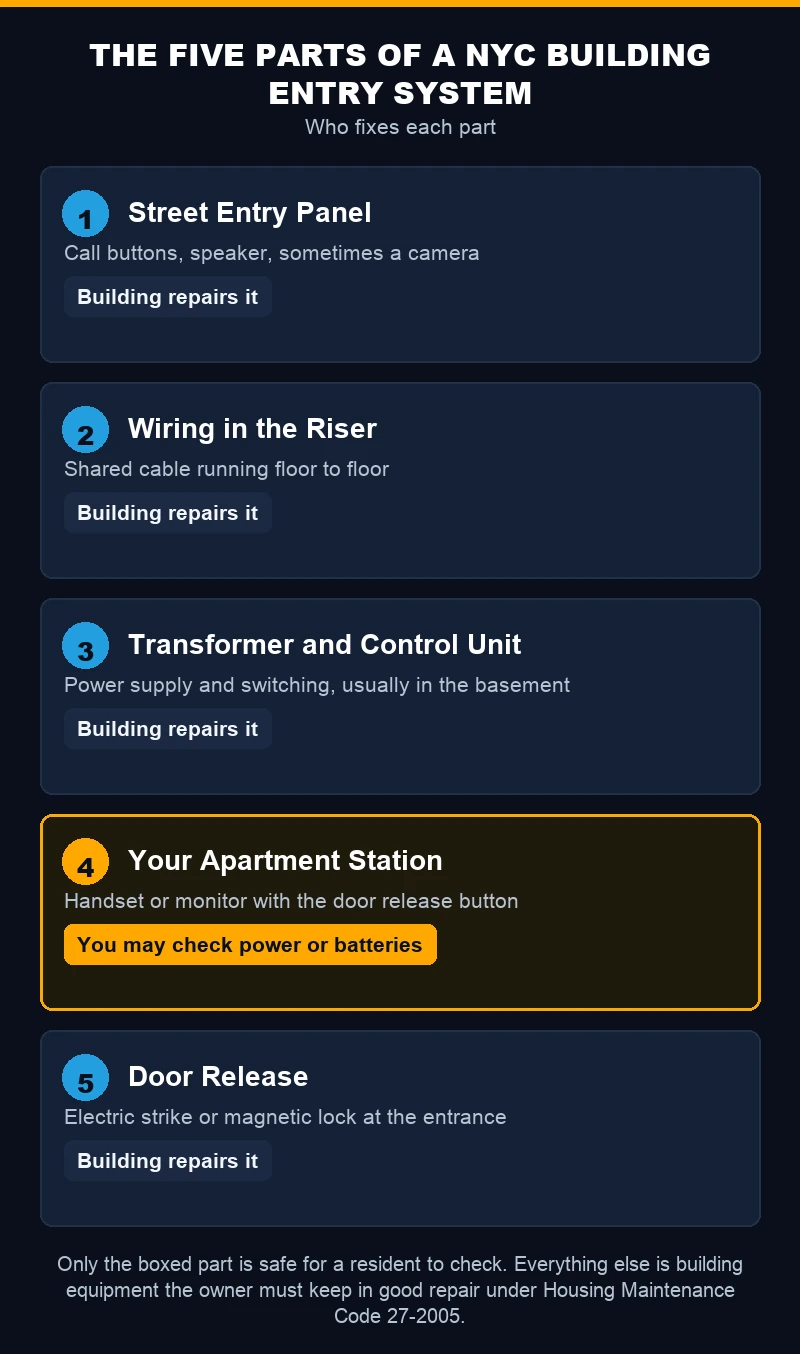
- The owner's: the entrance panel, the wiring, the transformer and control unit, the apartment stations, the door release, the vendor visit, and the bill. Section 50-a does let the owner of a pre-1968 building recover the cost of equipment installed at tenant request, through the process in that statute.
Two things I tell people to skip: do not deduct from rent on your own reading of the law, and do not hire someone yourself to work on the building's system.
If the dispute moves from the buzzer to your own door, that is a different law with criminal penalties behind it. See can my landlord change the locks in NYC for what counts as an illegal lockout and what to do in the first day.
When a Licensed Locksmith Installs or Upgrades an Intercom or Buzzer System
Management calls us when the checks above have run out. Here is what my technicians find, in rough order of how often it comes up.
- Corroded connections at the street panel. Weather and decades of paint kill the terminals behind the buttons. On a walkup this is often a same-visit repair.
- A failed transformer or power supply. The classic whole-building symptom: every apartment goes silent at once.
- A worn electric strike, which is the powered catch in the door frame. Voice works, the door does not release, or it buzzes and still does not open because the frame has shifted.
- One dead apartment station. Usually a single handset or monitor swap, not a building project, as long as parts for that model are still made.
- A system with no parts left. That is the honest replace conversation, when a building looks at a modern video entry system or at access control for the front door.
Top Notch Locksmith & Security is a licensed and insured locksmith and security company based in Manhattan, serving apartment buildings, co-ops, condos and businesses in all five boroughs of New York City. Audio and video intercoms, buzzer systems, door hardware and residential locksmith work are our daily jobs, so a super can hand us a 1970s panel and get a straight answer on repair versus replacement.
Frequently Asked Questions
Is a broken intercom a housing code violation in NYC?
It can be. Section 27-2005 of the New York City Housing Maintenance Code says the owner of a multiple dwelling shall keep the premises in good repair, and a Housing Preservation and Development inspector can write a violation for a broken building system after a 311 complaint.
Who fixes an apartment intercom, the landlord or the tenant?
The building owner. The panel at the front door, the wiring, the power supply and the door release are all building equipment, so the owner or managing agent arranges the repair, not the resident.
How long does a landlord have to fix a broken buzzer in NYC?
There is no single deadline for the first ask, and the New York Attorney General says repairs must be made within a reasonable time based on how serious they are. Once Housing Preservation and Development writes a violation, the clock is set by the violation class: 90 days for Class A and 30 days for Class B.
Does my landlord have to give me a video intercom?
No. Multiple Dwelling Law section 50-a calls for two-way voice communication between each apartment and the front door in covered buildings with eight or more apartments. Video is an upgrade a building can choose, not something the statute requires.
Can I put in my own buzzer or intercom in my apartment?
Not on the building system. An apartment station is wired into shared risers and a shared power supply, so work on it goes through the owner. A wireless doorbell inside your own apartment is a different thing and does not replace the building intercom.
Get the Buzzer Working Again
If you are the super, the owner, or the board member holding this problem, we will look at the panel, the wiring and the door release, and tell you whether it is a repair or a replacement before any work starts. We answer the phone 24 hours a day across the five boroughs. Call (646) 781-7070 or send us the building details.