
You went down to drop off the trash, the door clicked shut behind you, and your keys are sitting on the kitchen counter. Now you are in the hallway with a phone at nine percent, reading a page that tells you to slide a credit card into the space beside the latch. Will that actually work? Will it wreck the door? And if you rent, do you call your building's superintendent first, or a locksmith? A good share of the lockout calls I take come in about twenty minutes after somebody tried the card. Some of them come from people who just looked up what the building has to put on that door, and found out there is more lock in front of them than they thought.
An inside door, like a bedroom or a bathroom, you can usually open yourself in about a minute. A front door or an apartment entrance door is a different machine, and the tricks you are reading about were designed out of locks in 1952.
- Bedroom and bathroom knobs have a small hole in the middle of the outside knob. That hole is the way in, and it is there on purpose.
- Your front door latch has a second, smaller plunger sitting right beside it. That little plunger stops a credit card.
- On a New York City apartment door you are usually beating two locks at once, sometimes three.
- Forcing the door costs more than the visit. A chewed up cylinder, a bent latch and a split frame are all parts and labor on top of the call.
Where that comes from: Schlage patented the little plunger back in 1952, and the patent says in writing that it is there to keep the latch from being pushed back by anyone who is not using a key.
I am Roye Gvili. I run Top Notch Locksmith & Security out of Manhattan, and my technicians open doors in all five boroughs every day of the week. By the end you will know which doors you can open yourself, why the card trick fails on a front door, what is really bolted to a New York apartment door, what to try before you call anybody, and what it costs you when a door gets forced.
Key takeaways
- If a credit card does open your front door, the strike plate is out of line and a stranger can open it too.
- Picking a lock leaves it working. Drilling one means paying for a new cylinder, so ask which a phone quote covers.
- Your building's superintendent is a faster call than a locksmith, and usually a free one. The management office is not the same person.
- Hinge pins on an entrance door face the inside of the apartment, so taking the door off from the hallway is not an option.
- New York treats carrying lock picking tools as a crime when the plan is to get into somewhere you should not be, so buying a bump key online is a bad answer to a bad night.
Which door are you standing at?
Every answer below changes depending on what is in front of you, so start here. Look at the outside of the door, at the knob or lever, and find which row you are in.
| The door | What is inside the lock | Can you open it yourself? |
|---|---|---|
| A bedroom or bathroom door | A privacy knob, with no keyhole and a release hole instead | Yes. The release is built for exactly this moment. |
| The front door of a house | An entry knob or lever with a deadlatch, which is the small second plunger beside the latch, and usually a deadbolt above it | No. The deadlatch blocks the card, and the deadbolt ignores it completely. |
| An apartment entrance door in the city | A heavy duty latch set and a deadbolt, and often a surface lock the tenant added | No. You are being stopped by two or three locks at once. |
In the first row, you are three minutes from being back inside. Here is how that one goes.
How to open a bedroom or bathroom door without a key
Here is the part that saves you a phone call. A privacy lock is not built to stop anybody. It is built so a person in the bathroom gets privacy, and so somebody outside can still get that door open when a toddler turns the button or an older parent does not answer.
Here is what is happening inside that knob. The button you push on the inside slides a small bar across. That bar keeps the outside knob from turning. The manufacturer then drills a hole through the middle of the outside knob so that same bar can be moved back from the hallway. Push the bar back and the outside knob turns again.
So you need something straight and stiff that fits the hole:
- Find the hole in the outside knob. It sits dead center, and it is about the width of a coat hanger wire.
- Pick your tool. A straightened paperclip works. So does the small key that came taped to the box. On some knobs the hole is a slot instead, and a small flathead screwdriver or a coin turns it.
- Push it straight in, not at an angle. You are looking for the bar about an inch and a half back. Push until you feel it give, or turn the slot a quarter turn.
- Turn the knob while you hold the pressure. On most knobs the button pops back out on its own once the door opens.
If there is no hole and there is a keyhole instead, you are at an entry lock, and the next section is for you.
Why the credit card trick does not work on your front door
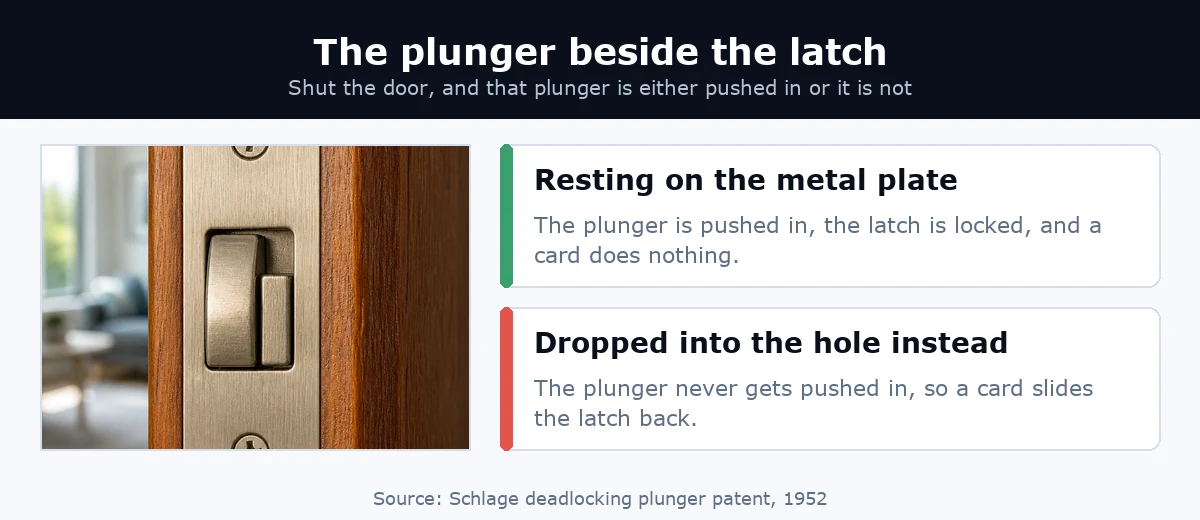
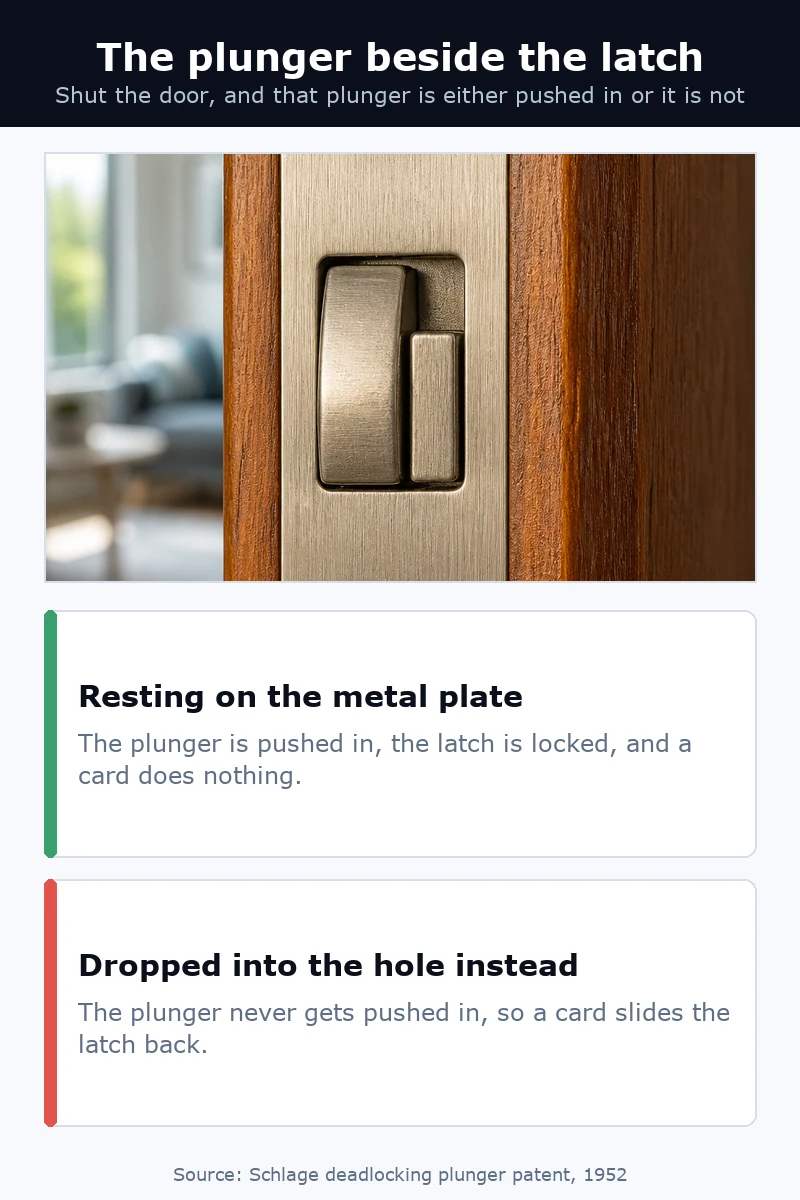
Open your front door and look at the edge of it while the door is still open. You will see the angled latch everyone knows about. Right next to it, there is a second piece that is smaller and flat. That second piece is called a deadlatch, and almost nobody notices it until somebody points at it.
Here is what the deadlatch does when you shut the door. The angled latch drops into the hole in the frame. The smaller plunger does not, because it lands on the flat metal strike plate instead and gets pushed in. While that plunger is pushed in, it blocks the main latch from sliding back. So the latch is now locked in place, and pushing on it with a card does nothing at all.
This is not new, and it is not a premium feature. Schlage patented the idea in 1952, and Locksmith Ledger quotes that patent describing a deadlocking plunger meant to prevent "retraction of latch bolt by unauthorized means" while the strike plate holds the plunger in. Seventy plus years later, it is on the entry locks sold at every hardware store in the city.
There is one honest exception, and it is a warning rather than a tip. When the strike plate is out of line, the little plunger falls into the hole with the main latch instead of resting on the metal, and then the door is not deadlatched at all. Kwikset lists that same misalignment in its own latch troubleshooting, along with a bolt hole that was never drilled a full inch deep. If a card opens your door, a stranger can open your door, and that is a strike plate worth fixing this week.
What is actually on a New York City apartment door
Most of this comes down to city rules, which is why apartment doors here feel heavier than the ones you grew up with. Section 27-2043 of the Housing Maintenance Code says the owner has to give you a key lock and at least one key. In most apartment buildings it goes further than that: the door needs a heavy duty latch set plus a heavy duty deadbolt you open with a key from the hallway and a thumb turn from inside. The same section adds a chain guard.
Then tenants add their own. State law lets you put one more lock on your apartment door, and plenty of people use it for a surface mounted jimmy proof lock, the kind with two vertical bolts. That lock throws straight down into a plate on the frame, so there is no latch edge for anything to reach.
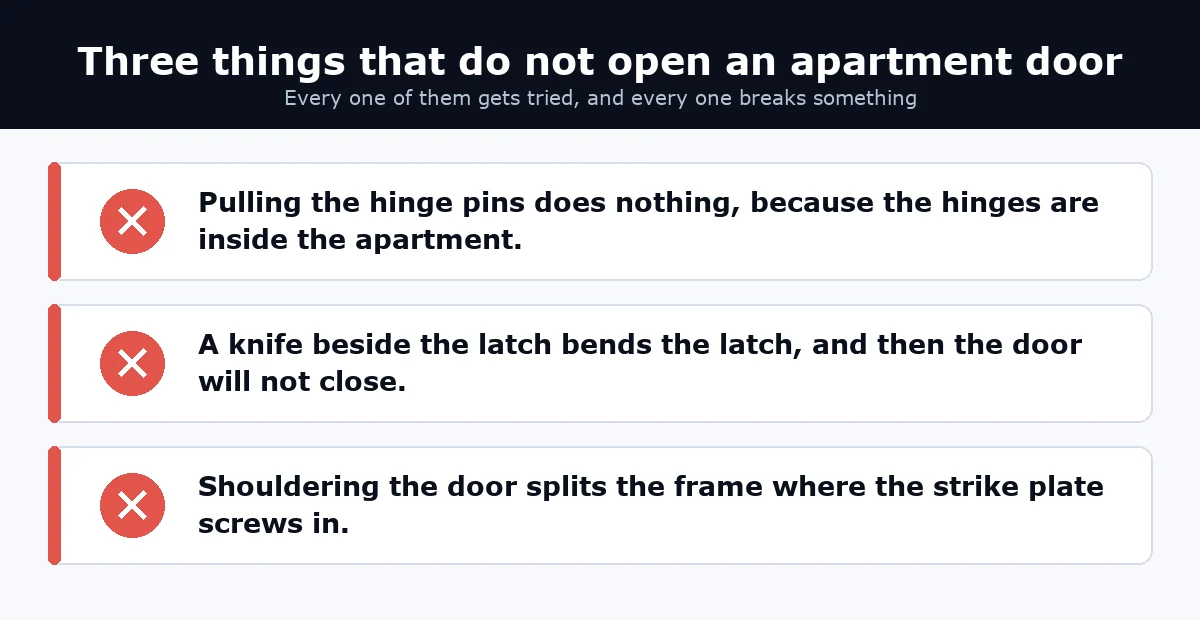
Two more things people read online that do not apply here. Taking the hinge pins out is house advice, because apartment entrance doors are hung with the hinges inside the apartment. And pushing a knife in beside the latch is a way to bend that latch and still be in the hallway, only now the door needs a new lock before it will close properly.
4 things I tell people to try before they call anybody
Run these in order. On a good night one of them is the whole answer, and none of them cost you anything.
- Call the superintendent, not the management office. The superintendent, or super, is the person who looks after your building day to day, and in most buildings that person lives on site or a block away and holds a master key for the lock the landlord put on your door. Your landlord or managing agent is the office that owns the building and keeps the paperwork. Both can get you a key, but only one of them is around at midnight.
- Check the door you forgot about. A back door, a service door off the kitchen, a terrace slider. People check the front door twice and never walk the rest of the apartment.
- Text the spare key holder before you call them. A text lands on a bad signal when a call drops, and it gives them your address in writing while they are looking for shoes.
- Ask yourself who else is on the lease. If a roommate is at work with a key, a subway ride is cheaper than any locksmith in the city, and you can wait in a coffee shop instead of a hallway.
When none of those land, the next question is how much damage you are willing to do to the door. The honest answer is none.
What forcing the door really costs
A lockout is a small job. Everything people do to avoid paying for a small job is a bigger job.
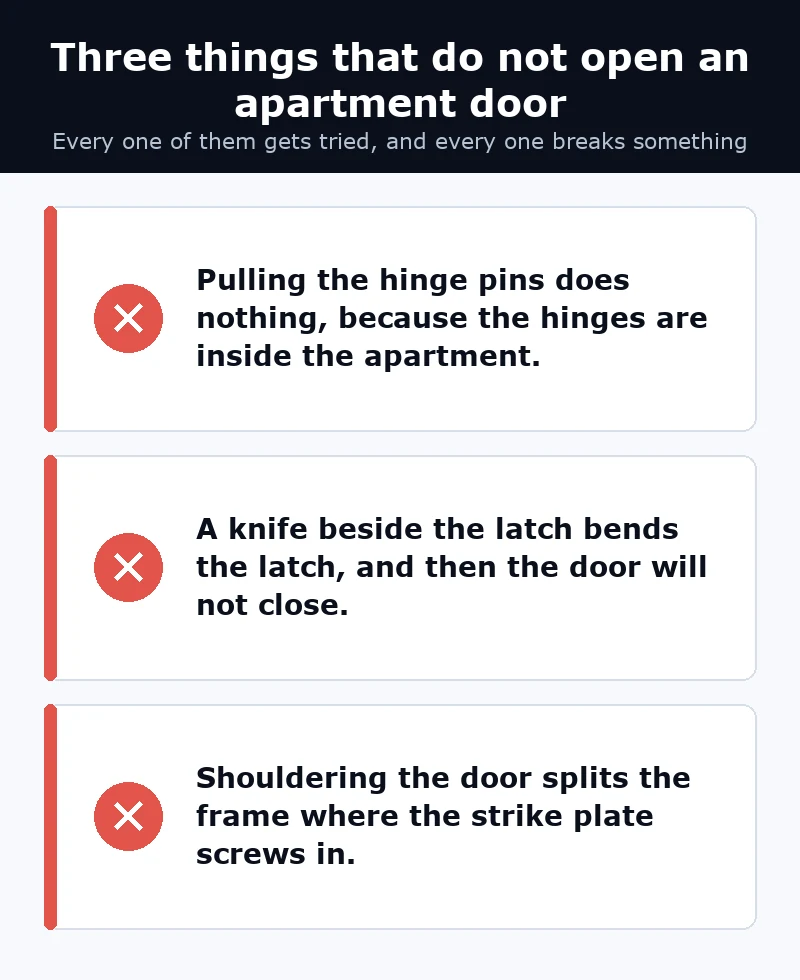
A screwdriver in the keyhole rounds off the inside of the cylinder, so a key will not turn it even after the door is open and the cylinder gets replaced. A knife bends the latch, and a bent latch either will not close or will not open. Shouldering the door splits the frame where the strike plate screws in, and that is carpentry before it is hardware. None of those three end with you paying less than the call you were trying to skip.
There is a legal edge worth knowing about too, because the internet loves to recommend buying a bump key. Under Penal Law 140.35, carrying a tool made for forcing entry is a class A misdemeanor in New York when the circumstances show you meant to use it on a place you should not be in. Your own apartment is not that. Standing in a hallway at one in the morning with a bag of picks and no ID that matches the address is a conversation nobody wants to have.
What happens when a locksmith gets there
Here is the part people are nervous about, so it is worth saying plainly.
First you get asked for identification with that address on it, a lease, or a piece of mail. A technician who does not ask is a technician to send away. Then the lock gets opened, and on most doors that means picking it, which leaves the lock working as it did before. Drilling is the last resort and it comes with a new cylinder, so ask which one a phone quote covers.
If your key went missing rather than got left inside, say so, because the honest next step is rekeying the cylinder rather than just getting the door open. And if the key snapped off in the lock instead, that is a different job with different tools.
FAQ
My phone is about to die. What do I do first?
Text one person who has your spare key, then call the locksmith, in that order. A text goes through on a weak signal when a call will not. If you live in a building, add your superintendent to that text. And say your cross streets out loud on the call, because a dispatcher who has your corner can send somebody even if the line drops.
It is my apartment, but my name is not on the lease. Can a locksmith still let me in?
Bring what you have and say so on the phone. Mail with your name at that address, a piece of identification with the address on it, or the leaseholder on speakerphone all help. A technician who opens any door for anybody who asks is the one you should worry about, so the questions are a good sign. In a building, the super knowing your face settles it faster than anything in your wallet.
Is it cheaper if I get the door open myself and just have the lock fixed after?
It is usually the other way around. Opening a door is a service call. Replacing a cylinder somebody chewed up, straightening a bent latch and patching a split frame are parts plus labor on top of that same call. The one exception is a bedroom door, where the release in the knob is free and takes a minute.
What if the key is inside the lock on the other side?
Say that when you call, because it changes the tools. A key left in the cylinder on the inside blocks a pick from the hallway on many locks. There are ways around it, and they take longer. Expect a bigger job than a plain lockout, and expect the technician to ask whether anyone else is home first.
I got in through a window. Should I still call anybody?
Call somebody about the window, not the door. A window a locked-out person can reach is a window anybody can reach, and that is the part worth fixing this week. While you are at it, find out why the door locked behind you in the first place. A latch that fires on its own usually means the door and the frame stopped lining up.
Stuck in the Hallway Right Now?
We open apartment and house doors in Manhattan, Brooklyn, Queens, the Bronx and Staten Island, and most of them get picked rather than drilled. Call (646) 781-7070 and tell us which locks are on the door, or send us a photo of the outside of it if you are planning ahead.